Dead words in writing is a catch-all expression to describe words and phrases that are unnecessary, weak, or overused.
Every word has its place. But in writing, the words you choose should be in the right place and for the right reason.
At the top of the list are hackneyed phrases such as due to the fact, quite frankly, that being said, or at the end of the day. As for weak words, just, very, and really are always candidates to be zapped from a text.
To help you find dead words in your writing, you can use the free dead word checker below to scan your text and highlight any weak or unnecessary words.
The Free Dead Word Finder
Identifying dead words in writing becomes much easier when you can quickly see where they appear in your text.
Paste your writing into the tool below to instantly detect weak or unnecessary words that may be affecting your sentences.
Dead Word Checker
Instantly find dead, vague, fluff, or unnecessary words in your writing.
This dead word checker scans your text and highlights common weak words that often add little meaning to a sentence.
These words usually include vague or unnecessary modifiers such as very, really, quite, or just, along with other expressions that make sentences longer without improving clarity.
By spotting these words quickly, you can identify places where your writing may sound less precise or unnecessarily wordy.
Once the words are highlighted, you can decide whether to keep or delete them.
You might also decide to replace words with better vocabulary or rewrite the sentence for better clarity.
You can click on any highlighted word to show a quick advice tip about the word or phrase. A little light editing can make a noticeable difference by tightening your writing and making your ideas more direct.
If you want to get the best results, the next section explains how to use the tool to quickly identify and reduce dead words in your writing.
How to use The Dead Word Checker
Using the dead word checker is quick and only takes a few seconds.
Start by pasting up to 1,000 words of your writing into the input text box. You might want to check a few paragraphs, a full article section, or part of your manuscript.
Next, click the Analyze Vocabulary button to start reviewing your text.
The tool instantly scans your writing and highlights words that are commonly considered dead words.
You will then see the number of words detected in your text along with a vocabulary strength percentage.
Below this summary, you’ll see a list and frequency of words in your text so you can identify patterns, especially when the same weak word appears several times.
When reviewing the results, consider whether each highlighted word is necessary.
In many cases, simply removing the word will make the sentence clearer and more direct.
Sometimes it’s better to replace a word with a stronger alternative or a more precise description.
But don’t try to score 100%. Many structural words cannot be replaced. If you score around 90%, you are doing very well.
Pro Tip: If you want to revise and edit your text, simply click the Edit My Text button, edit your writing, and click Analyze Vocabulary again to update the results.
You can repeat this process as many times as you like until your writing becomes clearer, more concise, and precise.
When you are happy with your revisions, you can then choose to copy or download your edited text.
If you’d like to understand more about dead and vague words and why they weaken writing, continue reading the explanation and examples below.
How to identify dead words
Any word or phrase can be weak or dead if it is overused in a piece of writing.
Every writer has tic or habit words that always seem to creep into their writing.
The challenge is to find and replace or delete these when editing or proofreading.
If a word or phrase is overused, it’s usually an easy fix.
However, some words, such as the verb to be, are more difficult to classify.
It’s because, in some cases, the verb is necessary, but in others, it’s not the best choice.
A good example is with the dummy subject of there are, there is, or there were.
It’s almost always possible to rewrite these sentences, as in this example.
There were over one hundred people at the wedding. (Weak)
Over one hundred people attended the wedding. (Stronger)
My top 100 candidates
Creating a complete list of dead words is impossible.
It always depends on the context and how you use a word or phrase.
However, here’s a list for you of one hundred words and phrases I believe are often prime candidates to consider removing or replacing.
Each word or phrase has suggestions for replacements or advice to omit.
One observation, though, is that some words on the list are only weak when overused.
The suggested replacements could also be weak but stronger when used less frequently.
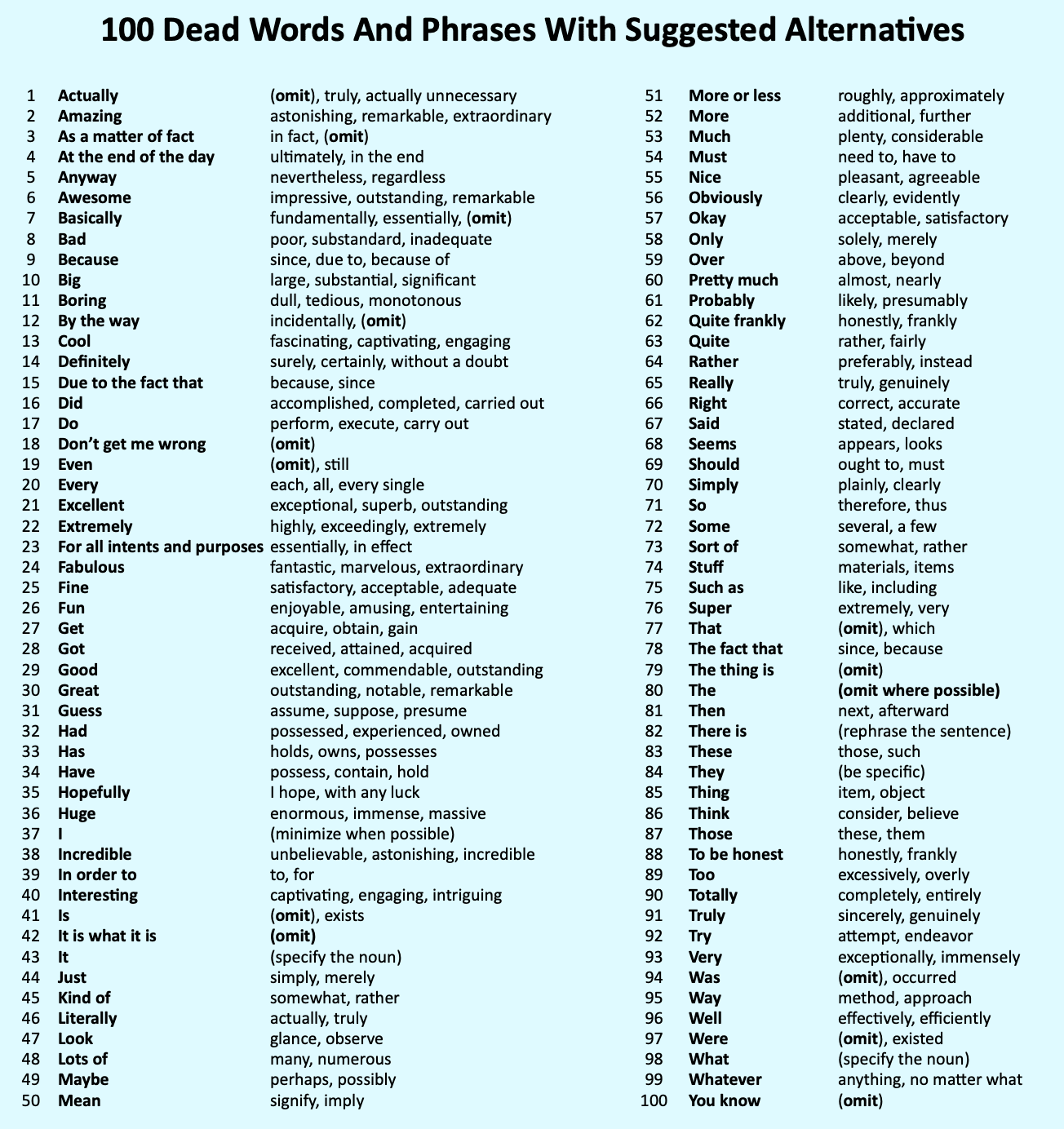
You don’t need to follow the list to the letter, as it’s not a set of golden rules or forbidden words.
However, it might give you some ideas about your choices of vocabulary and where you might improve.
Many of the suggestions can help make your writing stronger. For example, you might consider replacing it or what with nouns.
Actually, naturally and evidently, I only included a few LY adverbs to avoid.
However, almost every LY adverb deserves consideration about how appropriate it is in any writing.
Most of the time, you can find better solutions.
As for the remaining suggestions, it’s up to you to decide if they are helpful.
Seven words that are always candidates
No matter what you are writing, these handful of dead words are always well worth replacing.
Very: Try replacing very big with large, huge, or enormous.
Really: Change really good to excellent or outstanding.
Just: Just another day could change to another day or a typical day.
Some: Possibly replace some with many, a few, or numerous.
Things: It is a true vague word. Try replacing it with specific nouns or using aspects or elements.
Amazing: One of the most overused words, so it often loses its power. Try opting for incredible, extraordinary, or remarkable.
Stuff: It’s similar to things but even more vague. Specify what you mean with specific vocabulary.
Conclusion
You don’t need to go to the extremes of writing as if you were trying to win a six-word challenge.
Incidentally, contrary to popular belief, Ernest Hemingway didn’t invent this form of ultra-short flash fiction.
However, being economical with words is good advice.
It’s not the word count that matters; it’s the story or information in content writing that does.
In writing, no word or phrase by itself is a dead word.
It’s only about how, when, where, and how often you use it.
Related Reading: 10 Writing Rules That Are Waiting To Be Broken

English teacher, writer, and author. Passionate about grammar, creative writing, and self-publishing. Always exploring new tools and tech to help writers succeed.