If you use free writing tools, will they help make you a better writer?
No, they will rarely improve your writing skills, but they can help you spot things you might miss.
That’s the big upside with online writing tools, because you can treat them as a second pair of eyes.
Keep in mind, though, that if a tool tells you something is wrong, it doesn’t necessarily mean it is wrong. You’re still in charge.
Where free writing tools can help you
No writing tool can teach you how to plan and write a great story, come up with original ideas, or develop your writing voice.
But using an appropriate tool can help you spot problems that are surprisingly easy to miss when you’re reading your own work.
I use a range of tools to help me write more productively and accurately, but never rely on one tool.
That’s a trap I learned to avoid a long time ago. Grammar and writing checkers can often differ when checking the same text or miss obvious errors.
I always use three tools now for any new text I write: two online grammar checkers, and my eyes.
But there’s more to improving a text than simply checking grammar and spelling, and that’s where specific free tools can help.
Over time, I collected a little list of tools that I found helpful, and more recently, I’ve created my own tools for specific issues.
One of my pet peeves is repeated words, sometimes called echo words. I couldn’t find a tool that worked well, so I built my own tool to graphically display repeated words in a text.
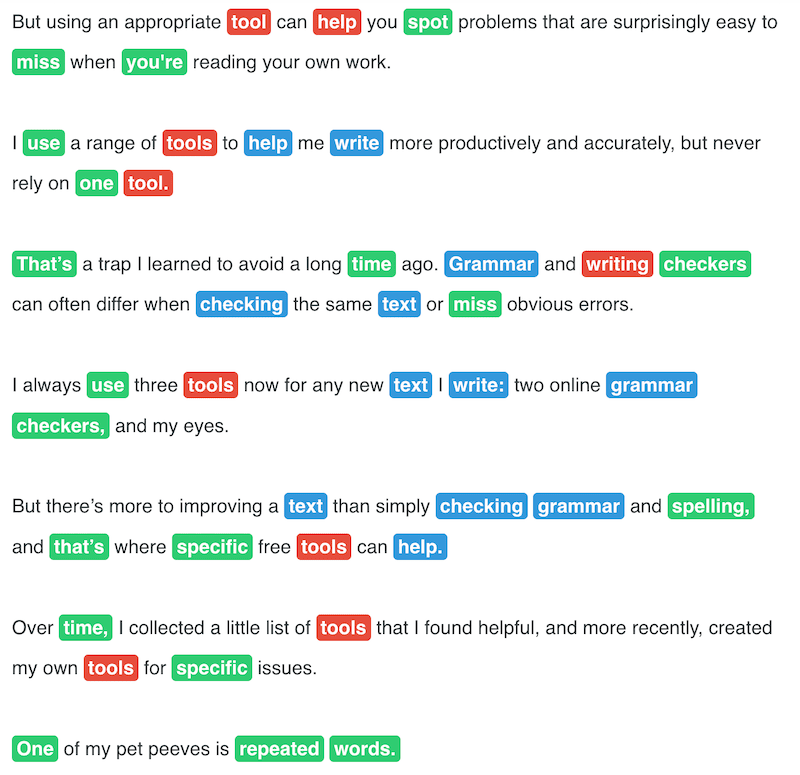
As you can see, I still have a little bit of work to do on my text to reduce the number of repeats in this text.
Free tools for specific tasks
I guess most writers now use a general writing checker like Grammarly, ProWritingAid, or Quillbot.
And that’s a good thing. Tools like these can really help you check and correct grammar issues, spelling mistakes, and punctuation.
But there are some writing checks that these tools don’t cover.
Yes, some tools can tell you whether you have a good or poor mix of sentence lengths, but I never found a way to see where I needed to improve or adjust my sentence flow.
Because of that weakness, I built this tool to help me identify problems with my sentence variety and rhythm.
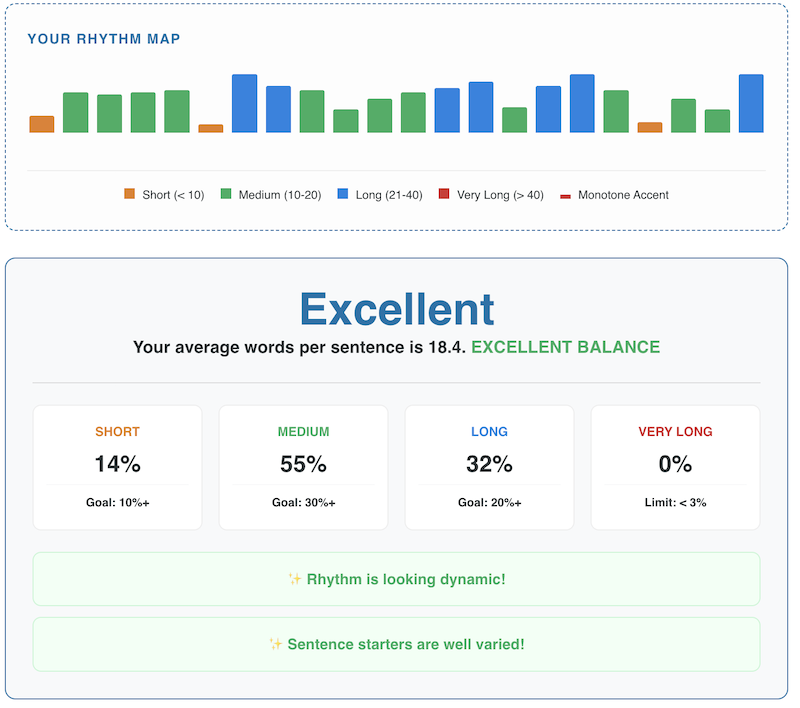
You can see that my text is doing much better on this front than echo words.
Another online tool I use quite frequently shows the differences between two texts. I find this very useful when working with revisions.
And it’s a good example of a free tool that does one thing only, but does it well. You might not use it every day, but if you bookmark it, you’ve got it at your fingertips when you need it.
One aspect of fiction writing that can be confusing or hard to quantify is how well you show rather than tell a story. I read a lot about it over the years, but I couldn’t always judge how well I was doing.
I wanted to see what was happening in my writing, and this is the result.
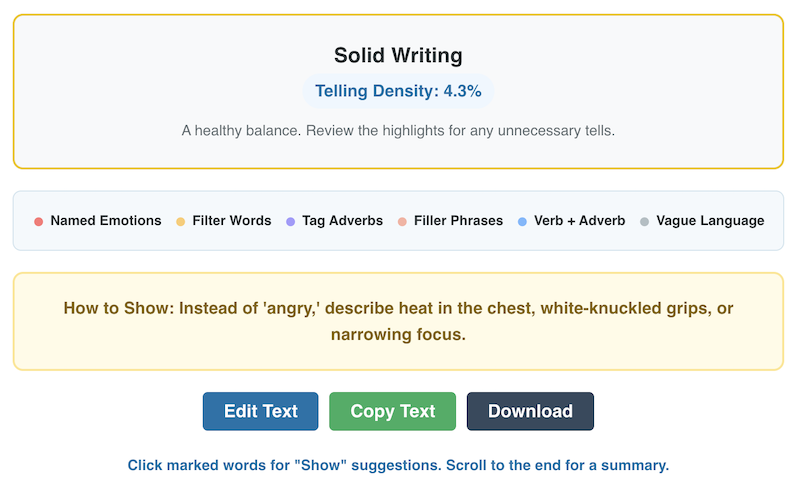
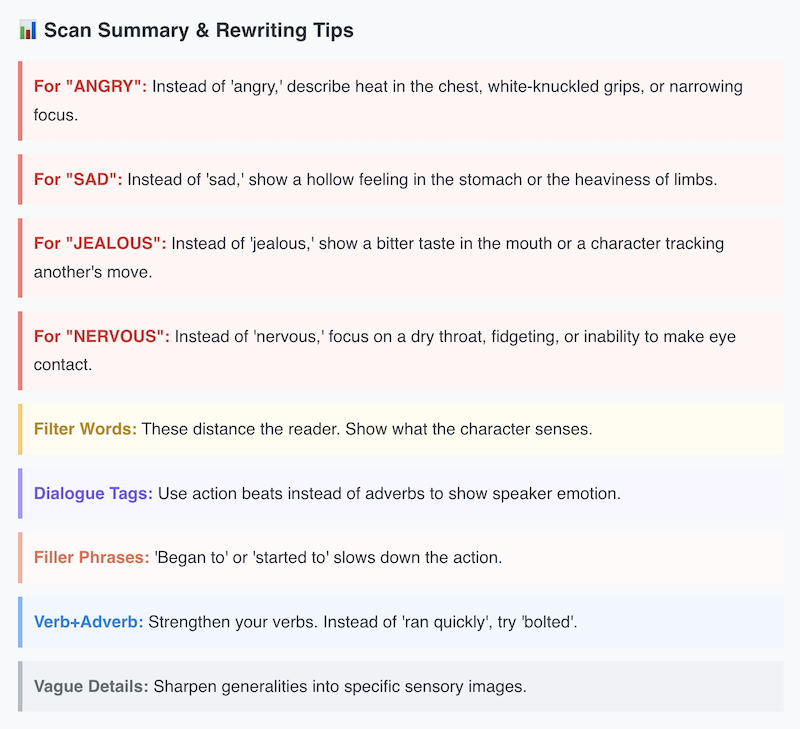
Now you and I can see how much telling there is in my text, and where it occurs.
What tools do you need to help you?
You certainly don’t need a collection of one hundred tools.
But if you can identify where you might strike some difficulty, you can often find a free tool to help you with that one issue.
It might be to check for overused phrases and clichés, highlight your adverb use, or help you find dead words in your writing.
If you know your weak points, that’s where a tool might be able to help you.
Of course, there’s more to writing than just writing.
Are you thinking about using a pen name and need ideas?
Maybe you want help with creating believable characters, or setting targets for your beta readers.
If you’re self-publishing, you might be struggling with keyword and category choices. For a blogger, it might be a headline or title analyzer.
In all these cases, you can probably find an online tool to help you.
A tip for inventive writers
Can’t find a tool you would like to use? Why not create your own?
With so many free AI assistants to choose from now, you don’t need to know a thing about coding to develop a web app.
I only have a basic grasp of CSS and HTML, but I’ve managed to create some useful tools with the help of AI-assisted coding.
It can take a few back-and-forths to iron out little bugs, but I can usually end up with a fully functional app. However, I’ve also had a few failures that I couldn’t get over the line.
If you’re adventurous, it’s an option for you if you can’t find a tool you would like to have. Another bonus is that if it works well, you can share it with your blog readers.
Summary
Good writing comes from the head and heart, and no amount of tools can replace that.
Sure, you can generate loads of text using AI, but that’s not writing.
Your writing has a unique voice, and it’s the product of your imagination, knowledge, expertise, and curiosity.
When you can combine those elements, you’re a writer. But writing drafts are never clean or error-free, and that’s where useful free writing tools can help.
You don’t want someone leaning over your shoulder, but having a small set of tools on hand for specific tasks can help you save on editing and proofreading time.
You won’t want to rely on them for 100% accuracy, but they can help you identify weaknesses and opportunities for improvement in your text.
Related Reading: More Free Writing Tools For Authors And Writers

English teacher, writer, and author. Passionate about grammar, creative writing, and self-publishing. Always exploring new tools and tech to help writers succeed.