Like a print book, you should always start an ebook chapter on a new page.
It gives a reader an expected break, which is part of making ebook reading as natural as possible.
However, pages in an ebook are not fixed like a printed book. They are flexible and depend on a reader’s device to determine the page size and where page breaks occur.
Because of this, you need to format your manuscript correctly to ensure that all devices recognize a clear page break before a new chapter.
The correct way to start a chapter on a new page
What you see in your word processor is not always how it will look in an ebook.
One common problem is relying on repeated presses of the Return key to create space before a new chapter. These blank lines may not be preserved when you convert your manuscript to an ebook.
When you want to add any kind of space in an ebook, you need to use proper formatting.
For a new chapter to start on a new page, you have to insert a page break in your word processor immediately after the last line of the previous chapter.
That will tell any ebook reading device that what follows will start on a new screen page.
As long as the next part of your text is a chapter heading, it will appear at the top of a new page.
In print books, a new chapter usually falls on a right-hand facing page, so there can be a blank page between chapters.
But in an ebook, there are no left or right facing pages or blank pages.
As long as you insert a page break, or chapter break if your word processor includes this, your new chapters will begin on a new page. But always check the converted ebook to make sure the breaks appear as intended.
One last thing to check is that there are no blank paragraphs or unnecessary line breaks between the end of a chapter and the next chapter heading.
Formatting your chapter titles
All your chapter titles should use the same heading style. These are usually Heading 1 or Heading 2.
I prefer to reserve Heading 1 for the book title and use Heading 2 for chapter headings.
However, the most important thing is to use a consistent heading structure throughout your manuscript.
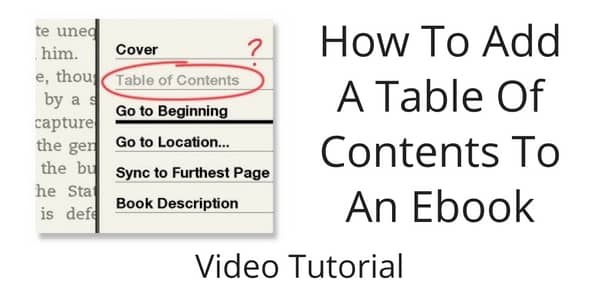
Most ebook conversion tools and publishing services can use heading styles to help create a table of contents automatically.
As long as all your chapter titles use the same heading style, you can format them consistently by modifying the style settings.
You can change the font size, style, and positioning of all your chapter titles at once.
After a page break, your chapter title will normally appear at the top of the next page or screen.
You might prefer to move it a little lower. To do this, use the paragraph settings in your heading style to add space before the title.
You can add a little or a lot of space, even positioning your chapter title halfway down the page.
You will probably also want some space between your chapter title and the start of the chapter text.
Adjust the heading style’s paragraph setting for space after to control the amount of space you prefer.
Readers might not consciously notice a well-placed chapter title, but it helps create a clear and visually appealing break in your book.
Remember, though, that readers can change font settings on their devices.
Depending on the ebook format, conversion software, and reading app, some of your font styling may be changed or overridden.
Relative font sizes and emphasis, such as bold or italic, may be preserved, but you should always preview your converted ebook to see how your chapter titles actually appear.
Checking your formatting
You can use one or more of the many ebook previewing tools available to check your manuscript formatting.
One popular option is Amazon’s free Kindle Previewer.
It’s relatively simple to use and is ideal for checking chapter breaks, heading styles, and spacing in a Kindle ebook.
If you want more options, including the ability to edit EPUB files, you can use Calibre.
It’s free to download and install, and is sometimes described as the Swiss Army knife of ebooks because it offers so many tools and features.
If you prefer a simpler method, some word processors, such as Apple Pages, can export documents directly to EPUB.
You can then transfer the file to a compatible reading device or open it in an ebook reading app on your phone or tablet.
Even if you’re confident that your formatting is correct and your ebook is ready to publish, always perform one final check using the preview tool provided by your self-publishing service.
Summary
If you plan to self-publish both print and ebook versions of your new book, you will usually need two differently formatted manuscripts.
For a print book, the formatting you see on your screen will often be close to how your book appears in print, although you should always check the final print-ready file.
For an ebook, however, you can’t rely on what you see in your word processor.
You need to use the correct formatting so ebook conversion software and reading devices can display your text properly and start an ebook chapter on a new page.
As a reminder, one common mistake is using the Return key or Shift+Return repeatedly to add space within an ebook manuscript. These extra line breaks are not a reliable way to control ebook layout.
Instead, use proper page breaks and consistent heading styles, along with the paragraph and style settings in your word processor.
Generally, formatting your body text and chapter titles correctly, then previewing the finished ebook, is enough to provide a pleasing reading experience.
Related Reading: 10 Common Ebook File Errors And How To Avoid Them

English teacher, writer, and author. Passionate about grammar, creative writing, and self-publishing. Always exploring new tools and tech to help writers succeed.