

A lot of outdated grammar rules come from 17th-century Latin-based standards that never truly suited the English language.
If I can give a quick teacher’s verdict: yes, you can end a sentence with a preposition, start with a conjunction, drop whom in most cases, and happily split your infinitives. Modern English is about natural expression, not obedience to obsolete myths.
Most major style guides, including the Chicago Manual of Style and Oxford, now prioritise readability over these older restrictions. Clinging to these “zombie rules” can make writing feel dated, overly formal, or unnecessarily complex rather than clear and professional.
That said, understanding where these rules came from helps you know when breaking them improves writing, and when it doesn’t matter either way.
Why grammar rules become outdated
Grammar evolves over time, as language adapts to the way we actually communicate.
What was considered strictly correct decades ago may no longer reflect how English is used in modern writing and speech.
So why does grammar change?
Because language is constantly adapting to changing communication needs.
One of the biggest drivers of that change is digital communication. It encourages more informal writing styles and accelerates how quickly language adapts to cultural shifts.
As a result, some traditional grammar rules have become less relevant, or in certain cases, obsolete.
This doesn’t mean grammar no longer matters, or that anything goes.
Good grammar is still essential for clear, effective writing.
However, as a teacher, I’ve noticed a steady shift away from rigid, traditional rules that can sometimes limit natural expression in modern writing.
I’ve highlighted some of the most common outdated grammar rules below that I’ve encouraged students to ignore, adapt, or apply more flexibly depending on context. If you’re short on time, you can skip ahead to an infographic summary.
1. Never split the infinitive

This rule started to disappear in the ‘60s when Star Trek announced it was to boldly go where no one has gone before.
Since then, splitting the infinitive has become commonplace.
If you want to say, I need to quickly finish this report before noon, that’s fine now.
Sure, you could say, I need to finish this report quickly before noon.
But it doesn’t place the emphasis on the verb; it’s on the object.
So feel free to happily split the infinitive to modify or intensify a verb.
2. None is singular
The old rule for subject-verb agreement with none was that none meant not one, so it was always singular.
But this is no longer the case, as none can also mean not any.
So, it can now be singular or plural, depending on the context.
None of the windows was broken, sounds wrong now, even though it is grammatically correct.
It’s far more logical to say, none of the windows were broken.
The same goes for: none of my friends is married. None of my friends are married, sounds much more appropriate.
3. Collective nouns are always singular
This rule is debatable. US English is still quite strict about its use, but in other varieties of English, you often see the plural form.
For example, it’s not uncommon in British English to read that Apple are losing iPhone market share.
It all depends now on context and accepted usage.
Yes, you would almost always say, my team is winning.
But equally, you could say, my team are celebrating with the coaches and their families.
Sure, if the focus is on a single unit, it’s still singular.
However, if the focus is on members or individual elements within a collective unit, you can often use a plural verb.
4. Never end a sentence with a preposition
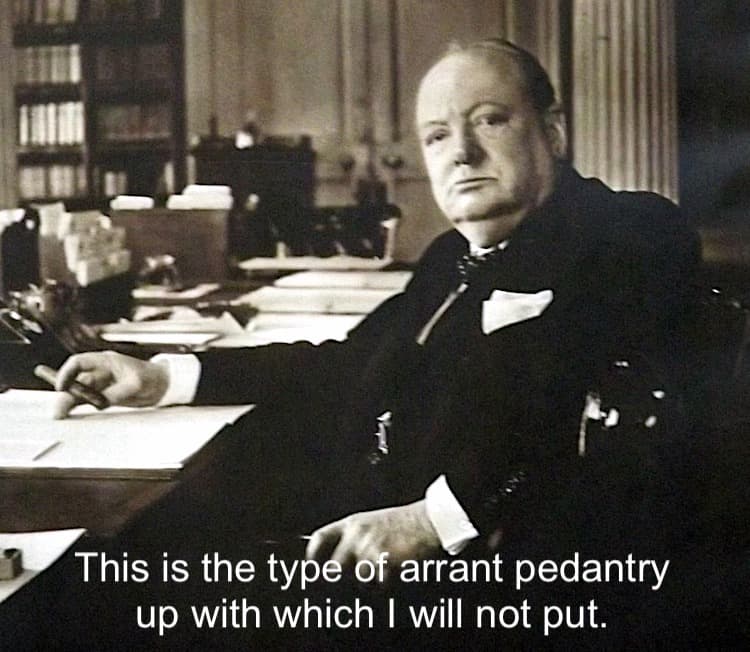
This rule was drilled into me when I was at school.
But times have changed so much since then, and when it sounds natural, you can certainly finish a sentence with a preposition.
Even Winston Churchill had a problem with it a long time ago.
Consider this phrase. Who are you going to Italy with?
There is only one way to change this sentence so it doesn’t end with a preposition.
With whom are you going to Italy?
It is overly formal and simply doesn’t work in today’s English.
So, forget this rule ever existed.
5. They is always plural
This one is a rule where changes in society have rapidly changed grammar.
For a long time, using they to represent a singular (particularly a person) was a major grammar fault.
But, in fact, singular they or their has been around for centuries.
Oh, look, somebody forgot their jacket.
The only way to follow the old rule would be to change this sentence to read, Oh look, somebody forgot his or her jacket.
Today, using they as a singular is most often to accommodate inclusive language so that the pronoun is gender-neutral.
6. Always use fewer with countable nouns
While it’s still a good idea, there are times when less will do.
We all know about the “8 items or less checkouts” in supermarkets.
No matter that it’s technically incorrect, it’s been in such everyday use for years now that no one would think to say, “the 8 items or fewer checkout.”
Okay, it pays to know the rule that less is for uncountable nouns and fewer is for countable nouns.
But if you are happy saying that you noticed less cars on the road this morning, then don’t worry too much.
Use what you think sounds natural.
7. Never use contractions in formal writing
I spent years drumming this rule into my students’ heads, telling them to use contractions only when writing an informal text.
But times have changed, and this is no longer a hard and fast rule.
The vocabulary choices and grammar structures of formal writing still apply. However, contractions and even acronyms are now quite acceptable, but in moderation.
These two sentences highlight the relaxation of the rule.
Regretfully, the Chief Executive Officer informed the committee that he was not able to attend the hearing. (Strict formal)
Regretfully, the CEO informed the committee that he wasn’t able to attend the hearing. (Relaxed formal)
8. Avoid sentence fragments
Sentence fragments used to be a no-no, but now you see them everywhere in advertising, social media, news articles, and literature.
We had a terrific time. In spite of the weather.
To correct this, it should probably read: In spite of the weather, we had a terrific time.
But when used intentionally, sentence fragments can add extra emphasis to a phrase.
In the example above, using a sentence fragment adds more emphasis on having a terrific time rather than on the weather.
However, this is one rule where it’s probably better to know the rule before you break it.
9. Don’t start a sentence with a conjunction
Using conjunctions like but, and, so, or for at the beginning of a sentence used to be considered poor writing.
However, starting sentences with conjunctions often adds reason or connectivity to your writing.
So, if it feels right, go ahead and start your sentence with any of the FANBOYS. (For, And, Nor. But, Or, Yet, So.)
10. Use whom to refer to the object of a verb
Well, this rule is so far out of date that it’s hardly worth mentioning.
It’s always so overly stuffy and formal, and it’s a headache to try to remember the rules.
With whom did you go to the cinema? Yes, it’s 100% correct.
But this is far better. Who did you go to the cinema with?
Forget all about the word whom, unless you are writing a reference for an employee addressed to: To whom it may concern.
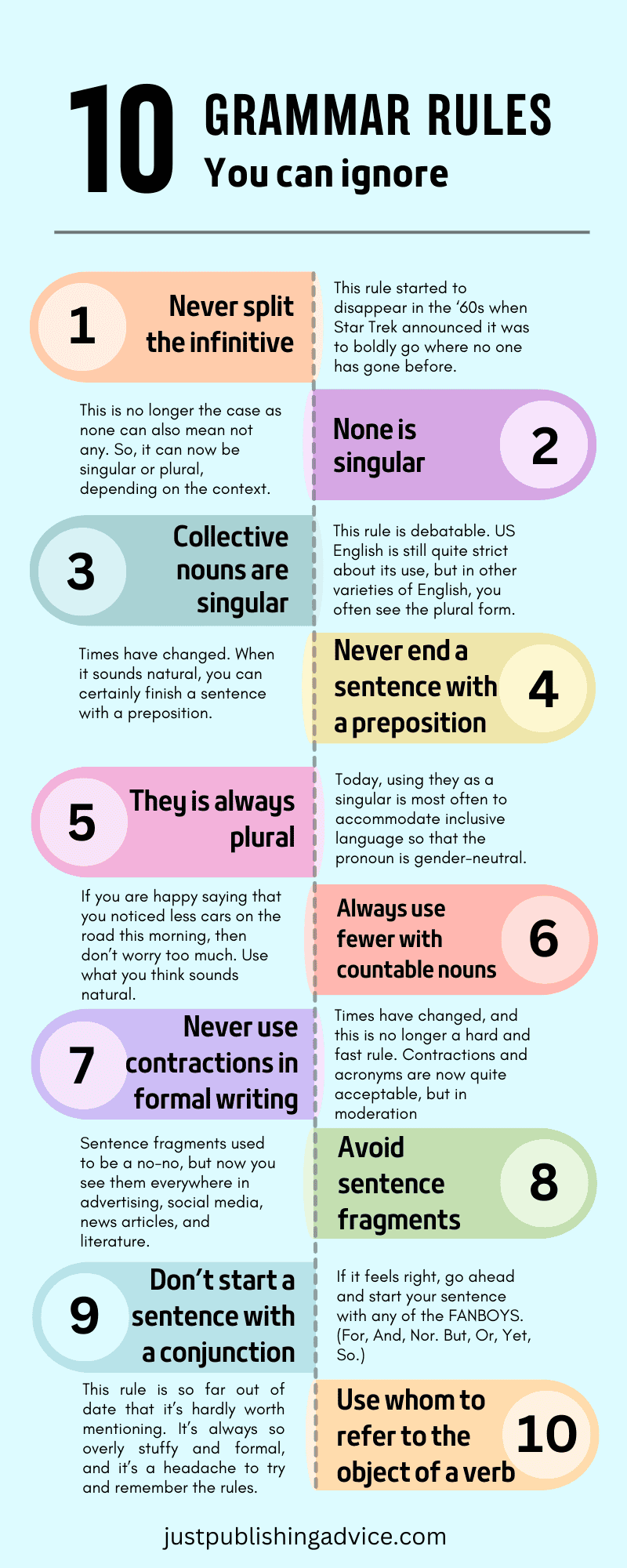
Summary infographic
Here’s a quick summary of the grammar rules you can ignore today.
Right-click to download and save the image.
Conclusion
Good sentence structure, grammar, and avoiding obvious errors will always make writing easier to understand and more professional.
But language is constantly evolving, and grammar rules evolve with it.
As a teacher, I still see the value of strong grammar knowledge because it’s essential for clear writing. However, I’ve also seen how focusing too much on outdated rules can waste time and distract from what really matters, which is clarity and natural expression.
So don’t let old rules limit your natural writing voice.
Focus on what makes your writing clear, natural, and effective, and not what outdated rules say it “should” be.
Related Reading: 7 Quick Rules For Verb Agreement With Group Nouns

English teacher, writer, and author. Passionate about grammar, creative writing, and self-publishing. Always exploring new tools and tech to help writers succeed.


Good article and it accurately reflects how the language is currently used without caving into outright solecisms. One (perhaps) correction. While ending a sentence with a preposition was long “streng verboten,” in English, that rule itself crept into English from Latin. Older writing never scrupled to end a sentence with a preposition. It’s good to see a “new” development returning English to its roots.