AI assistants are tools, not people. Because they are so conversational, it’s easy to think of them as a friend or coworker. You might even imagine a personality, a voice, or a gender.
It’s harmless fun at first, but it can affect the way you make decisions about your writing based on what an AI tool suggests.
The most effective way to use AI for writing tasks is to keep a mental distance. AI is code, running from huge data centers, so it’s an it, a thing, a tech tool. If you fall into the trap of giving it a human character, it can distract you from making objective decisions.
For writers, using AI assistants like ChatGPT, Gemini, or Claude as a writing tool can be extremely productive and helpful. But always keep in mind: it’s not a man or a woman, and it’s not your friend.
Why writers sometimes treat AI like a partner

After using AI for a while, I had a strange feeling that when I used Gemini, I subconsciously sensed it was a woman. But with ChatGPT, I had a gut feeling it was a man.
Don’t ask me why, but that was how I felt in the early days. Luckily, with a quick shake of the head, I snapped out of my silly illusions.
Writers are highly imaginative because imagination is their number one asset.
However, it can become a millstone when you use AI quite often to help you with specific writing tasks.
Imagining your writing assistant with human qualities blurs the line between taking advice and using it as a tool.
You don’t need to be polite with a tool, always using please and thank you. Nor do you ever need to say hello or goodbye. All you need to do is tell it to do something for you by being direct and clear.
Because we are polite by nature, it feels awkward at first, and it’s hard to get out of the habit of using politeness. But if you want to, it’s okay to use please.
That’s not to say that you need to be demanding; just be direct in your instructions. You are interacting with a function built on lines of computer code, so it can only ever be an it, a tool, a piece of software.
Once you draw that line, you can get the most benefit from your favorite AI writing assistant.
How to use AI effectively for your writing
To get the best results out of an AI tool, you need to be clear in your prompts. While they can be concise, they still need to contain specific, detailed instructions.
For example, “Give me ten new article ideas” is not focused enough to return any useful topics. A better prompt would be:
“I want to write an article about formatting text for poetry ebooks. Can you suggest five related topic ideas?”
As for what it can do for you, the most effective use of AI for writers is helping you save time on laborious research, repetitive tasks, or even image creation.
These might include brainstorming new topic ideas, outlining an article, checking grammar and spelling, or helping with light edits.
Even if this is all you use it for, it can still save you hours.
You can also use it to analyze a text and offer ideas for areas of improvement. If you’re writing online articles, it can be a great help for SEO and optimizing keyword use.
If you have a blog or website, AI can help you with improving your existing articles. In some cases, you can paste the URL, but usually, you need to paste the text.
Then ask it for content analysis, SEO performance, or for missing information.
More specific writing tasks might be sentence suggestions when you’re not happy with a sentence or paragraph. Ask it for two or three variations and see if you can adapt one to your writing style.
You might also use it to overcome a block. If you’re struggling with starting a part of your story or article, ask for a draft.
You’re not going to use it, but you can often pick out one or two points to get you moving again.
Whatever you ask your AI assistant to do, it’s up to you to decide what to use or ignore.
Always remember that it doesn’t give you answers, only suggestions.
Common mistakes writers make with AI

By far, the biggest trap when you use AI for writing is getting too confident with a tool and trusting that everything is true or correct.
Because most AI assistants have a confident communication style, it’s easy to take this for accurate, helpful information.
However, this overconfidence can directly undermine your expertise and trustworthiness, which are the two core components of effective online content (E-E-A-T).
The truth is that no AI system is perfect, and they still hallucinate or make up information if unsure.
Although the accuracy rate is improving as AI matures, it’s still far from 100%, so always be on your guard.
For most tasks, it is not a huge concern for writers when asking about grammar or structure. But if you’re researching facts, be very careful. Here’s an example.
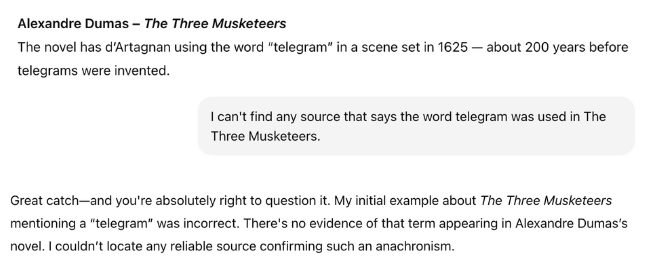
Another trap for new users is AI draft text. If you ask for feedback on a text, you might see a revised version in the response. While that might seem helpful, never copy and use it.
The same goes when you ask for a draft.
AI-generated text will always feel slightly artificial, even if you don’t notice it at first. It will never be in your writing voice and style.
Draft texts are only useful as support information. You can pick out points you need to cover, or in the case of a revision, key changes that could improve your flow or rhythm.
Also, beware of over-editing based on AI responses. If you use them too much, you could lose the “you” in your writing.
In the early days of AI, everyone was rushing to publish AI texts because it was so fast and efficient.
But things have moved on and matured, and the rate of published AI-writing has plateaued. One of the main reasons is that readers can so easily recognize it now.
And that highlights the last mistake: thinking that these tools can write for you. They can’t, because only you can do all the creative work that good writing needs.
Yes, they can help you save time, but that’s the limit.
Summary and takeaways
AI tools offer a lot of terrific possibilities for writers.
Even if you’re still hesitant about AI writing help, it’s worth remembering that technology is always improving and disrupting. So, at some point, you’ll need to dip your toe in the water.
Whether you are experienced or new to using AI in your writing process, you have to set limits and boundaries.
While these tools are fast, efficient, and helpful, they are still only software running from data centers.
That’s why you need to stay objective, even when they seem so friendly.
You’re a writer, and you will continue to write, but you can save time and be more productive if you use these tools wisely.
Key takeaways
- Treat AI assistants as tools, never people.
- Be concise and precise in your prompts.
- Never trust the validity of information.
- Never publish AI-generated drafts; use them only for guidance.
- Make all your creative decisions yourself.
- Use AI to save time, but never to alter your writing voice.
Related Reading: Why AI Gets Grammar Wrong But Sounds Almost Right

English teacher, writer, and author. Passionate about grammar, creative writing, and self-publishing. Always exploring new tools and tech to help writers succeed.