Pen name privacy is often seen as a digital mask, but a name alone isn’t enough to protect your true identity.
Every article you publish can drop “invisible breadcrumbs,” from hidden image metadata to innocent anecdotes that can lead readers straight to your door.
If you aren’t actively protecting your digital footprint, your professional firewall is likely thinner than you think.
Let’s take a look at your habits to make sure your pseudonym stays a secret and your “9-to-5” remains safely separated.
Anonymous writing under a pen name
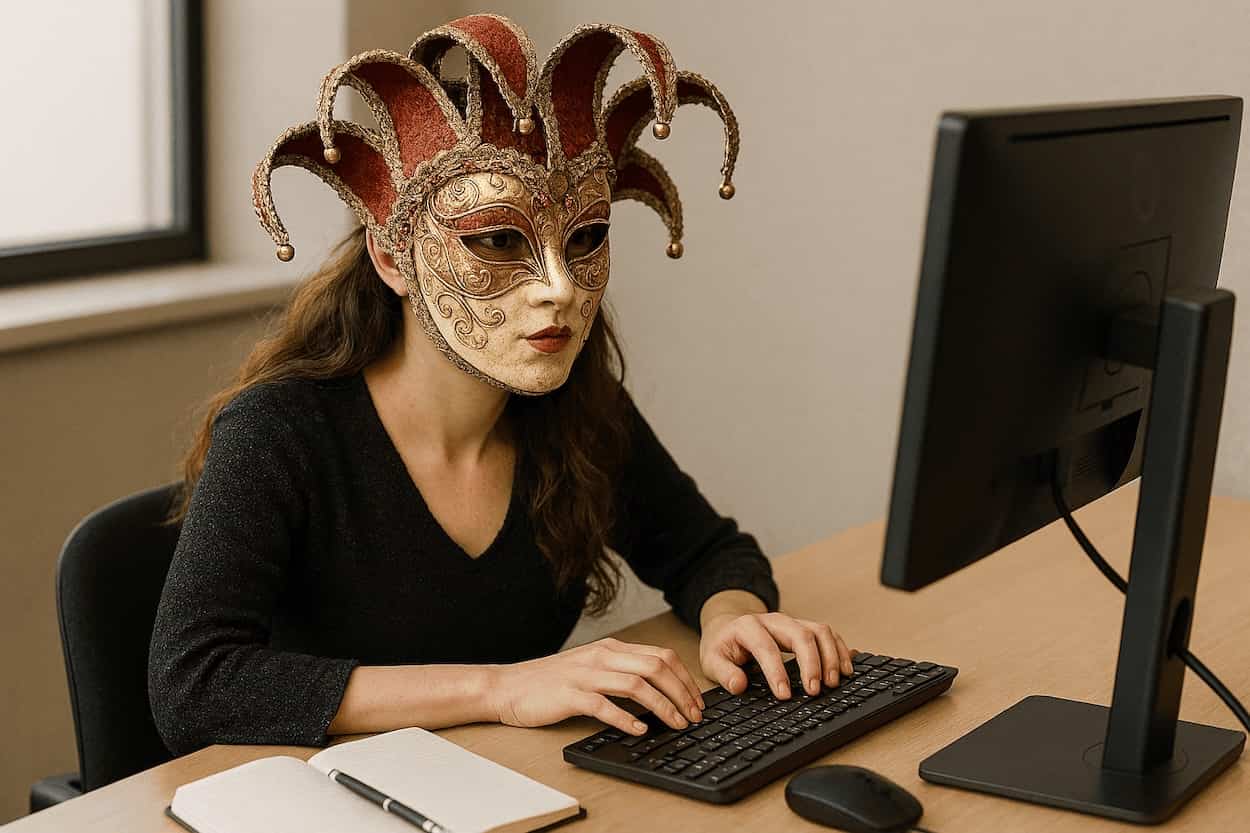
When you write anonymously under a pen name or pseudonym, you feel protected.
You can be honest, critical, or even spill the beans without fearing repercussions or reprisals.
Maybe you hide your identity as an author so you can write about sensitive topics.
Or as a blogger, to write about your industry without the fear of human resources connecting you to your articles.
But here’s a sobering truth: anonymity is not a mask you simply put on; it is a trail you have to stop leaving.
Some bloggers and authors believe that as long as their real name isn’t on the “About” page, they’re invisible or that a fictitious social media handle is safe to hide behind.
But they may not realize that they are in danger of dropping “little invisible breadcrumbs” with every paragraph.
From the voice of your sentences to “vague” anecdotes that aren’t nearly as vague as you think, your writing can have a fingerprint.
And if you aren’t careful, that fingerprint could lead your readers or your bosses straight to your front door. That’s why you always need to be on your guard to protect your pen name privacy.
The Power of the Mask: Writing in the Shadows
If you are considering an anonymous blog, you likely have a compelling reason. You aren’t just hiding; you are protecting something.
For many authors and bloggers, the decision to go “undercover” isn’t about being deceptive. It’s about wanting the freedom to be honest.
There are several understandable reasons why anonymity can be the right move.
The Ultimate Sandpit: For new writers and authors, a pen name is the perfect low-stakes environment.
It allows you to find your voice, make mistakes, and hone your craft without the weight of personal judgment or the fear of “ruining” your real-world reputation before you’ve even started.
The Professional Firewall: We live in an era where a personal opinion can easily be mistaken for a corporate stance.
Writing anonymously allows you to explore ideas that might conflict with your employer’s brand or your industry’s alignment, keeping your “9-to-5” and your “5-to-9” safely separated.
Radical Honesty: There are stories we tell ourselves that we aren’t ready to tell our mothers, our neighbors, or our colleagues.
Anonymity provides a sanctuary for sensitive or controversial topics, allowing your message to take center stage without the messenger being scrutinized.
A Shield Against the Noise: Let’s be honest: the internet can be a hostile place.
By maintaining a private identity, you create a buffer between your creative work and the potential for online harassment or personal negativity.
Whatever your “why” might be, a secret blog or writing under a pen name offers the rarest of luxuries today: peace of mind. You get to express yourself fully, but on your own terms.
However, that peace of mind only lasts as long as your identity remains a secret.
To keep your shield intact, you have to avoid the little “breadcrumbs” that many writers don’t even know they are dropping.
10 Ways to Scrub Your Invisible Breadcrumbs

To write effectively in the shadows, you have to be disciplined.
It isn’t enough to change your name; you have to change your habits. Here are some useful tips on how to stay invisible.
1. Secure Your Pseudonym
Create a name entirely unrelated to your real identity.
If even an invented name feels too personal, many platforms allow you to show the author as “Editor,” “Contributor,” or “Staff Writer.”
In some cases, you can even hide the byline entirely to keep the focus solely on the content.
2. Use a “Clean” Email Address
Never use your personal or work email to sign up for your blog or anything else.
Register a new email account that doesn’t include your name or birth year.
Use this address only for your blog and its associated interactions to keep your two worlds completely separated.
3. Choose Your Platform Carefully
Not all platforms are built for privacy. Use services like WordPress or Blogger that offer robust anonymity settings.
While some platforms require your real details for account setup, ensure those details are strictly “back end” and will never appear to your readers.
On platforms like Medium, you can be anonymous to the public while still being “verified” behind the scenes for payments, provided you set up your profile correctly.
4. The “Vague Anecdote” Trap
Avoid the temptation to share specific personal stories.
If you describe a “specific meeting at an insurance company in Boston,” anyone in that room could recognize you.
Keep your experiences vague, and if necessary, change the details. If a story happened in a bank, make it a real estate agency. If it happened in 2026, move it to 2024.
5. Scrub Your Images and Metadata
Never publish photos of yourself, your home, or your local neighborhood. But more importantly, be very aware of metadata.
When you upload a photo, it often carries hidden info (EXIF data) like the GPS coordinates of where it was taken.
Always strip the metadata or use a screenshot of the photo to create a “clean” file. Better still, use only stock images or AI-generated photos.
6. Build a Social Media Firewall
If you want to promote your work on social media, create entirely new accounts linked to your pseudonym.
Do not “Like” or “Share” your anonymous posts from your real-world accounts; the algorithm and your followers could eventually connect the dots.
7. Monitor Your Interactions
Be extra careful when replying to comments.
It is easy to let your guard down in a conversation and reveal a personal detail or an inadvertent mention about your location or history.
Always take a breath before replying to comments and make sure your response doesn’t include any “inside” knowledge.
8. Audit Your Privacy Settings
Privacy settings on blogging platforms can be updated or reset without warning.
Regularly double-check that your blog and social accounts are set to the highest possible privacy levels to limit unwanted public visibility.
9. Scrub Your Digital Paper Trail
Don’t connect your anonymous blog to personal email addresses or existing social accounts.
Also, be extremely careful with payment systems. If you plan to monetize your writing, you will eventually need to connect a bank account.
Make sure that the platform you use (like Medium or WordPress) allows for a “Display Name” or “Public Pen Name” that is entirely separate from your “Legal Billing Name.”
Without this separation, your payout settings could be the one breadcrumb that leads straight to your identity.
10. General Vigilance
While these steps offer significant protection, remember that nothing on the internet is 100% secure.
The goal is to take every reasonable precaution to ensure your “invisible breadcrumbs” don’t lead back to your door.
The Trade-Off: Weighing the Pros and Cons
Before you commit to the shadows, it is worth weighing the freedom of anonymity against the logistical difficulties. Here is what you can expect:
The Advantages
Total Creative Freedom: You have the liberty to explore topics that don’t align with your professional brand or family expectations.
A Personal Firewall: Anonymity offers a layer of protection from professional repercussions or personal negativity.
A Judgment-Free Sandbox: You can experiment with new genres or radical ideas without the weight of your real-world reputation holding you back.
The Disadvantages
The Trust Gap: It is objectively harder to build deep trust with readers when they don’t have a face or a real name to connect with.
Networking Friction: You’ll find limited opportunities to collaborate, guest post, or network with other experts who may be wary of anonymous creators.
Promotion Hurdles: Building a social media presence from scratch without leveraging your existing network can be a slow, uphill battle.
The Final Word
You don’t need to be a cybersecurity expert to write in the shadows. Unless you’re dealing with high-stakes whistleblowing, there is usually no need for complex VPNs or rotating IP addresses.
For the average blogger or author, pen name privacy and anonymity are simply about discipline.
By using a pseudonym, maintaining a strict firewall between your social accounts, and being hyper-aware of the “breadcrumbs” you drop in your writing, you can enjoy a level of creative freedom that most writers never experience.
Yes, writing anonymously comes with its own set of limitations. It’s a slower build and a quieter path. But the peace of mind and the ability to speak your absolute truth often far outweigh the drawbacks.
If you’ve been holding back on starting that blog or writing that book because you’re afraid of the repercussions, you might consider taking the leap.
Use these precautions, protect your identity, and finally let your voice be heard.
Related Reading: The Fear Of Publishing After Writing Your Book
Share This Article