
In fiction writing, telling verbs often flatten a sentence, causing you to miss opportunities to show action.
It’s easy to overuse verbs like was, seemed, felt, or had because they quickly summarize or move the story along.
Whenever possible, replace them with more descriptive, action-based alternatives. In other words, show the reader instead of telling.
Very often, a small edit is all it takes to turn a telling verb into a showing phrase.
What’s the difference between tell and show?
Telling verbs state facts or emotions directly, but give readers no information or details.
A classic example is, “She was angry.” All it does is tell the reader of her emotion without showing why or what made her feel that way.
However, when you show, you let readers understand or see the emotions through action, dialogue, or sensory details.
Instead of writing “He was nervous,” you could describe shaking hands, a rapid heartbeat, or unsure or quick glances around the interview room.
Showing touches the senses and imagination, making characters, settings, and events more dynamic and believable.
It helps readers see or feel what’s happening in the story, instead of simply reading about it.
Telling isn’t always bad, though. You can use it to quickly summarize unimportant moments, skip over time, or move the story forward a little faster.
But showing is often more memorable because it can create moments or scenes that linger in a reader’s mind for longer.
The best fiction writing balances both by using telling sparingly and showing where possible to control pace, tone, and impact.
When you can quickly recognize overused telling verbs, it’s your first step toward writing stronger, more descriptive scenes that can better capture a reader’s attention.
How do you change telling to showing?
The first step is to identify some of the classic telling verbs you have used in your draft. Search for words like was, seemed, felt, had, thought, or knew. For more, refer to the list below.
Highlight the verbs in your draft and see how often they occur. Look for passages where you might be using them in close proximity. You can use our “Show, Don’t Tell” tool to help you find these.
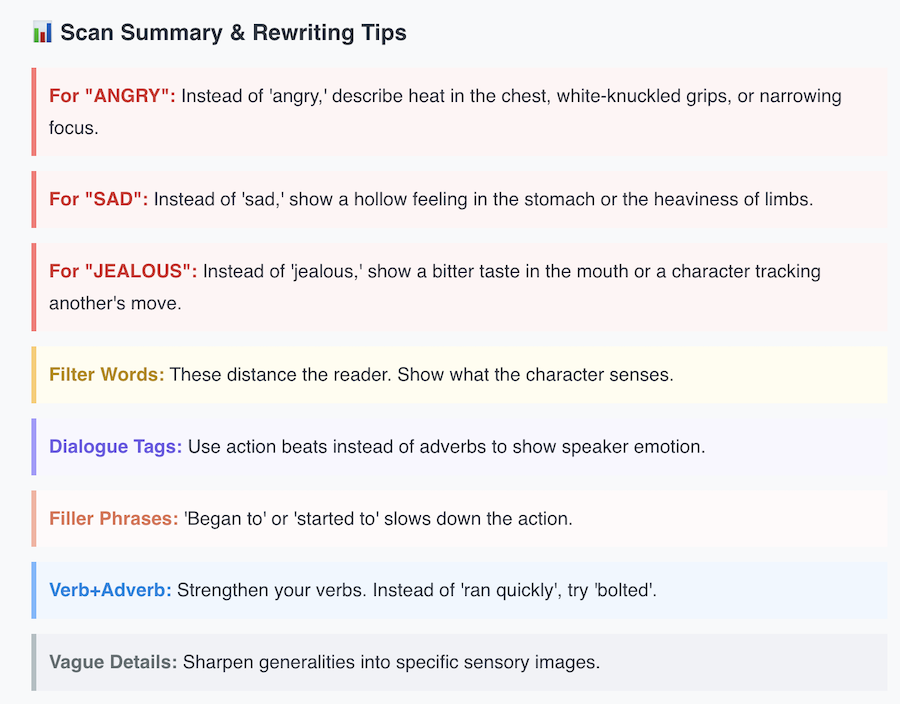 If you find clusters, that’s a telltale sign that you are doing a lot of telling. Now ask yourself what the verbs are doing in each sentence.
Are you stating something and skipping over giving your reader more detail or information?
Then think about what the character is actually doing, thinking, or sensing in that moment.
Replacing telling verbs or telling adjectives with actions, gestures, or expressions can help you reveal emotion quite naturally.
For example, instead of “He seemed frustrated,” you could write, “He ran a hand through his hair, leaned back in his chair, exhaled, scowling at the third negative reply on his screen.”
Instead of “She felt bored,” describe her tapping her pen on the desk, yawning, or glancing repeatedly at her phone.
Dialogue is a powerful showing tool. The way a character speaks, hesitates, or interrupts can show emotion far better than a single static verb.
Sensory details help, too. What does the character see, hear, smell, or touch? Even minor details make scenes more alive.
If you’re not sure where to start, try rewriting one sentence at a time. Focus on replacing just one telling verb with showing.
One trick is to visualize your character at that moment, then describe what you see. Do you see a tapping foot, a sweating brow, or shivering against an icy wind?
But remember, you don’t need to show everything. Some telling can help you cover minor events or summarize a scene. It’s up to you to decide which way is best for that part of your story.
With a bit of practice, spotting overused telling verbs will become automatic, and you’ll learn when to use showing for better effect.
25 Telling verbs in fiction writing (with showing alternatives)
Now that you know how telling verbs can weaken your writing, it’s time to spot them in action.
Below is a list of 25 common telling verbs used in fiction writing. For each one, you’ll see a simple “telling” example, followed by a stronger “showing” alternative.
Use this list as a quick reference while editing your work.
You don’t need to replace every instance, but learning to recognize these verbs will help you improve and strengthen your writing.
State-of-being verbs
1. Was (state-of-being verb)
Telling: He was nervous.
Showing: He drummed his fingers against the table.
Tip: Replace “was” with a visible action.
2. Had (generalizing verb)
Telling: She had a bad feeling.
Showing: A chill crept up her spine as she reached for the door.
3. Seemed (filters perception)
Telling: He seemed tired.
Showing: He rubbed his eyes and stifled a yawn.
Tip: Remove “seemed” and describe what proves it.
4. Appeared (filters perception)
Telling: He appeared calm.
Showing: He stood still, hands steady, voice even.
Emotion verbs
5. Felt (tells emotion directly)
Telling: She felt anxious.
Showing: Her hands trembled as she checked the clock again.
Tip: Show the physical effect of the emotion.
6. Liked (weak positive emotion)
Telling: He liked her.
Showing: He lingered, smiling at everything she said.
7. Loved (tells strong emotion)
Telling: She loved the place.
Showing: She breathed in deeply, smiling at the bustling streets.
8. Hated (tells strong negative emotion)
Telling: He hated the noise.
Showing: He winced and covered his ears as the sound rose.
9. Doubted (tells uncertainty)
Telling: She doubted his story.
Showing: She narrowed her eyes, folding her arms.
10. Hoped (tells desire)
Telling: He hoped for good news.
Showing: He checked his mail again, holding his breath.
Thought/knowledge verbs
11. Thought (summarizes thinking)
Telling: She thought it was a mistake.
Showing: She hesitated, rereading the message twice.
12. Knew (tells certainty)
Telling: He knew she was lying.
Showing: The twitch at the corner of her mouth gave her away.
13. Remembered (tells recall)
Telling: She remembered his warning.
Showing: His words echoed in her mind: Don’t trust him.
Tip: Let memories appear as fragments or echoes.
14. Considered (tells thinking process)
Telling: He considered leaving.
Showing: He glanced at the door, then back at the room.
15. Imagined (tells internal thought)
Telling: She imagined the worst.
Showing: Images of disaster flickered through her mind.
16. Believed (abstract judgment)
Telling: He believed it was hopeless.
Showing: He dropped the pen and stared at the blank page.
17. Realized (tells awareness)
Telling: She realized she was wrong.
Showing: Her expression faltered, and she looked away.
18. Understood (tells realization)
Telling: She understood the problem.
Showing: Her eyes widened as the pieces clicked together.
Tip: Show the “moment of realization.”
Observation/Perception verbs
19. Saw (filters observation)
Telling: He saw the man leave.
Showing: The man slipped out the door, pulling his coat tight.
20. Noticed (filters observation)
Telling: She noticed his frown.
Showing: A deep crease formed between his brows.
21. Observed (distances viewpoint)
Telling: He observed the crowd.
Showing: His gaze moved from face to face, searching.
Tip: Keep the reader inside the scene, not outside it.
Action/Intention verbs
22. Promised (tells intention)
Telling: He promised to help.
Showing: He met her eyes and nodded firmly.
23. Intended (tells plan)
Telling: He intended to speak.
Showing: He cleared his throat and leaned forward.
24. Acknowledged (tells reaction)
Telling: She acknowledged the problem.
Showing: She gave a slow, reluctant nod.
25. Wanted (tells desire)
Telling: She wanted to run.
Showing: She edged toward the exit, heart pounding.
Summary
Telling verbs are very easy to use, but they are often missed opportunities to make your writing stronger.
When you develop the habit of spotting them, you can turn flat tell sentences into showing.
You don’t need to edit or remove every telling verb, but use them for a purpose.
When you think a moment in a scene matters, showing will almost always be the better option.
With a little practice, choosing between telling and showing becomes an instinct, helping you write fiction that genuinely appeals to readers.
To speed up the process, you can use our tool to instantly highlight telling verbs in your writing.
Related Reading: How To Describe Things You Can’t See Or Touch

English teacher, writer, and author. Passionate about grammar, creative writing, and self-publishing. Always exploring new tools and tech to help writers succeed.