
If you are looking for other words for said, you aren’t alone. Every writer reaches a point where “he said/she said” feels repetitive, and you need a more expressive verb to capture a character’s tone.
However, before you dive into this list of 350 synonyms, it’s important to understand how to use them effectively. In his book “On Writing,” Stephen King famously argued that “said” is the best form of attribution because it remains “invisible” to the reader. Overusing flowery dialogue tags can often distract from the story itself.
But there are moments when a specific emotion, like a hissed threat or a whispered confession, requires a more descriptive tag.
Whether you are looking to replace a few repetitive tags or want to master the art of dialogue attribution, here are 350 other words for said to help you find the perfect voice for your characters.
Is “Said Is Dead” Still Good Advice?
For years, many writing teachers taught that “said is dead” and should always be replaced by more descriptive verbs. This led to a generation of manuscripts filled with characters who expostulated, remonstrated, and even ejaculated.
In dialogue writing today, the consensus has moved back. Many writers and editors now view “said” as an invisible tag; a functional attribution that lets the reader focus on the dialogue without being distracted by dialogue tag clutter.
However, you still have choices. To improve your dialogue, you need to know the three primary methods of attribution: the invisible tag, the action beat, and the strong synonym.
The invisible tag uses “said” or “asked.” Because these words are so common, the reader’s brain skips over them, keeping the rhythm of the conversation fast and the focus on the words being spoken.
An action beat replaces a dialogue tag entirely by showing what a character is doing. Instead of saying “Stop,” he said, you write “Stop.” He slammed his palm on the table.
Action beats are powerful because they show and don’t tell emotion. They allow you to ground the reader in the physical setting while simultaneously revealing a character’s state of mind through their movements.
A strong synonym is where our list of 350 words comes in. These are expressive verbs like bellowed, whispered, or hissed that describe the exact physical sound or intense emotion of the speech.
While strong synonyms are useful, they should be used like a spice. Too much will ruin the dish. Use them only when the dialogue itself doesn’t already convey the intensity of the moment.
To help you decide which method to use, it helps to see them side-by-side. Each serves a different purpose depending on the pace and emotion of your scene. The following table demonstrates how these three techniques change the feel of a simple sentence. Use this as a guide to balance your dialogue attribution.
Quick Attribution Methods
| Attribution Method | Example | Best Used For… |
|---|---|---|
| The Invisible Tag | “I’m fine,” she said. | Maintaining flow and keeping the tag “hidden.” |
| The Action Beat | She forced a smile. “I’m fine.” | Showing emotion through body language. |
| The Strong Synonym | “I’m fine!” she snapped. | Emphasizing a specific, sudden vocal shift. |
Avoid Overusing Adverbs in Dialogue
There are times when you can use a strong synonym to avoid adding a clunky adverb to a dialogue tag.
These descriptive verbs help you convey an extra element of emotion or tone of voice without using extra words.
When you choose a precise dialogue reporting verb, you can almost always avoid the use of adverbs.
You should keep your dialogue tags to a minimum to keep the pace of the story moving quickly.
I am sure every writer has read the famous quote about adverbs by Stephen King.
He once wrote: “I believe the road to hell is paved with adverbs, and I will shout it from the rooftops.”
When you are writing dialogue, you must be aware that tags are often the voice of the author rather than the characters.
Using an adverb like “he said angrily” often tells the reader what to feel instead of showing it.
Instead of relying on an adverb, try to find a single verb that carries the same weight.
For example, replacing “said loudly” with “shouted” creates a much sharper image for the reader.
When only two characters are speaking, it is often possible to avoid using tags almost completely.
This allows the reader to get lost in the rhythm of the conversation without distraction.
But when dialogue tag verbs are necessary, think carefully about your specific choice of vocabulary.
However, you should always go very easy on your use of adverbs in your dialogue writing.
350 Other Words For Said
There are times when you might want to make a line of dialogue a little more expressive.
Perhaps in a novel or short story, selecting alternatives for said can help you.
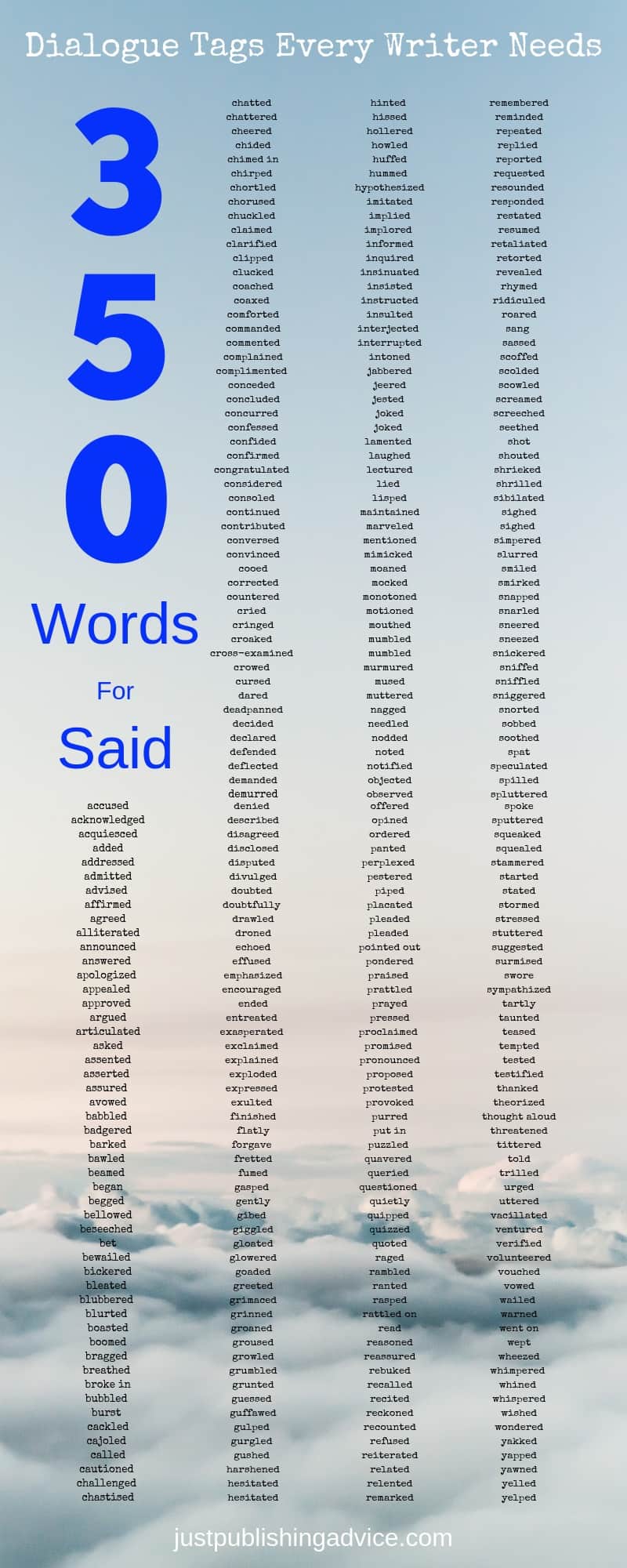
The infographic at the end of this article gives you a full list of 350 words you can use in place of said.
There is also a full-text listing with words for said categorized by emotion or association.
Using a one-word reporting verb is a much better alternative than adding an adverb to a dialogue tag.
They are quick and to the point. But they still give a sense of an understandable, emotive description.
Here are a few simple examples.
Bad: “I want to go home,” she said sadly.
Better: “I want to go home,” she cried.
Bad: “Where did they find it?” he asked curiously.
Better: “Where did they find it?” he wondered.
Bad: “Why did you do that?” he asked angrily.
Better: “Why did you do that?” he snarled.
Quick Category Guide: Finding The Right Tone For Your Dialogue
Before we dive into the complete alphabetical list of 350 verbs, use this quick-reference guide to find the exact tone you need.
These selections are grouped by specific emotions, actions, and narrative situations to help you match your character’s voice to the tension of the scene.
Whether your character is conceding an argument or exploding in rage, these targeted categories allow you to find a high-impact replacement for “said” without slowing down your writing.
Answering or responding
answered, conceded, concurred, explained, replied, responded
Confusion or uncertainty
wavered, guessed, hesitated, vacillated
Questioning or curiosity
asked, inquired, puzzled, queried, questioned, quizzed, wondered
Surprise
bleated, blurted, exclaimed, gasped, sputtered
Sadness or sorrow
bawled, bewailed, blubbered, cried, lamented, sniffled, sobbed, wailed, wept
Provocation or incitement
bragged, gibed, jeered, lied, nagged, provoked
Romance and love
breathed, promised, purred, sighed
Persuasion and inducing
advised, appealed, asserted, begged, beseeched, cajoled, entreated, implored, urged
Happiness and joy
beamed, bubbled, cheered, chirped, chuckled, giggled, grinned, joked, sang, smiled, trilled
Anger and rage
barked, cursed, exploded, fumed, growled, hissed, raged, ranted, roared, scowled, snarled, swore, yelled
Disgust or loathing
cringed, grimaced, groused, grunted, rasped, sniffed, snorted
Fear or anxiety
gulped, prayed, quavered, shrieked, squealed, stuttered, whimpered, whined
Embarrassment
admitted, confessed, hesitated, mumbled
350 Synonyms For Said Infographic
Now for the full list of verbs you can use instead of said.
You can use the infographic below for your writing reference. Or you can share it on your blog with your readers.
If you prefer, you can also view and download the infographic in pdf.
The Full-Text Listing Of 350 Words For Said By Emotion And Association
Feel free to copy and paste these words to replace said for your own use.
The emotion of ANGER
accused, argued, badgered, barked, bellowed, bickered, chastised, chided, clipped, clucked, commanded, complained, corrected, countered, cursed, dared, demanded, disagreed, exploded, fumed, goaded, growled, grumbled, harshed, hissed, hollered, howled, huffed, insulted, interrupted, muttered, objected, ordered, raged, ranted, retaliated, retorted, roared, scoffed, scolded, scowled, screamed, screeched, seethed, shot, shouted, shrilled, snapped, snarled, sneered, spluttered, stormed, swore, taunted, threatened, warned, yelled
The action of ANSWERING
answered, clarified, conceded, concurred, deflected, disputed, explained, interjected, protested, reassured, remarked, replied, responded, stated
The emotion of DISGUST
cringed, grimaced, groused, grunted, mocked, rasped, refused, smirked, sniffed, snorted
The emotion of EMBARRASSMENT
admitted, confessed, hesitated, mumbled
The emotion of FEAR
babbled, croaked, denied, doubted, fretted, groaned, gulped, moaned, panted, prayed, quavered, shrieked, slurred, squeaked, squealed, stammered, stuttered, whimpered, whined, whispered
The emotion of HAPPINESS
approved, beamed, bubbled, burst, cackled, chatted, chattered, cheered, chirped, chortled, chorused, chuckled, complimented, congratulated, cooed, crowed, effused, exulted, forgave, giggled, grinned, gurgled, gushed, hummed, joked, praised, resounded, sang, simpered, smiled, thanked, trilled
The emotion of LOVE or ROMANCE
breathed, expressed, proclaimed, promised, purred, sighed
Words associated with PERSUASION
advised, appealed, asserted, assured, avowed, begged, beseeched, cajoled, claimed, convinced, encouraged, entreated, implored, needled, pleaded, stressed, suggested, urged
Words associated with PROVOCATION
bragged, exasperated, gibed, jested, jeered, joked, lied, mimicked, nagged, provoked, quipped, sassed
The emotion of SADNESS
apologized, bawled, bewailed, blubbered, comforted, consoled, cried, lamented, mumbled, murmured, sighed, sniffled, sobbed, spilled, wailed, wept
The emotion of SURPRISE
bleated, blurted, exclaimed, gasped, marveled, perplexed, sputtered, yelped
Words associated with QUESTIONS or CURIOSITY
asked, challenged, coaxed, hinted, inquired, pleaded, puzzled, queried, questioned, quizzed, wondered
Words associated with UNCERTAINTY or CONFUSION
cautioned, wavered, guessed, hesitated, vacillated
NON-EMOTIVE
acknowledged, acquiesced, added, addressed, affirmed, agreed, alliterated, announced, articulated, began, bet, boasted, boomed, broke in, called, chimed in, coached, commented, concluded, confided, confirmed, considered, continued, contributed, conversed, deadpanned, decided, declared, defended, demurred, described, disclosed, divulged, drawled, echoed, emphasized, ended, finished, gloated, greeted, hypothesized, imitated, implied, informed, insinuated, insisted, intoned, instructed, jabbered, lectured, lisped, maintained, mentioned, monotoned, mouthed, mused, motioned, nodded, noted, notified, observed, offered, opined, pestered, piped, pointed out, pondered, prattled, pressed, pronounced, proposed, put in, quoted, rambled, rattled on, read, reasoned, recalled, reckoned, recited, recounted, reiterated, related, remembered, reminded, repeated, reported, requested, restated, revealed, rhymed, ridiculed, sibilated, sneezed, snickered, speculated, spoke, started, surmised, sympathized, teased, tempted, tested, testified, theorized, thought aloud, told, uttered, ventured, verified, volunteered, vowed, went on, wheezed, wished, yakked, yapped, yawned
Summary
Synonyms can always improve your writing by avoiding repetition.
Finding new words and new ways to say things is one of the pleasures of being a writer.
It doesn’t mean that you need to use long, uncommon, or complex vocabulary.
There are usually very simple alternatives for most words.
Considering other words instead of said is always a good idea. That’s even if said is a word that most people are blind to when reading.
By replacing said with a more active reporting verb, you can quickly add much more descriptive value to your novel or short story.
Related reading: How To Check Dialogue Writing Consistency In Your Manuscript

English teacher, writer, and author. Passionate about grammar, creative writing, and self-publishing. Always exploring new tools and tech to help writers succeed.


Thank you so much for this! I’m currently writing a book right now and finding synonyms for said is so hard! I really do appreciate this!
Thank you so very much for your generosity, time and shared talent in making this information possible. It will be an invaluable resource in my own writing efforts. I’m glad there are people like you around. Again. Thanks.
This article has helped me soooo very much! I use this article everytime I go to write more of my stories and (sort of) book. The organization into categories has been a life saver. Thank you!
I am so glad to have found u (here & on Twitter) All your articles and tips are like Gold to me!!!
Thank you so much for your work and Keep it up like this!!!!!
I adore your work and love your tips, it is like having a really great and wise Online Coach!
Everytime I take a visit here, I get a better writer / Blogger / Promoter too!!!
U Rock!!!
Thank you. I’m happy to hear that our content is useful to you.