
Have you noticed book title keyword stuffing when searching for a new book or ebook on Amazon? It’s getting harder to miss.
If you’re not sure what stuffing looks like, here’s a perfect example.
“My Million Dollar Experiment: The World’s Largest Metaphysical Money Experiment—Where Mindset, Intuition, and a Million-Dollar Plan Helped 1 in 268 Participants Become Millionaires”
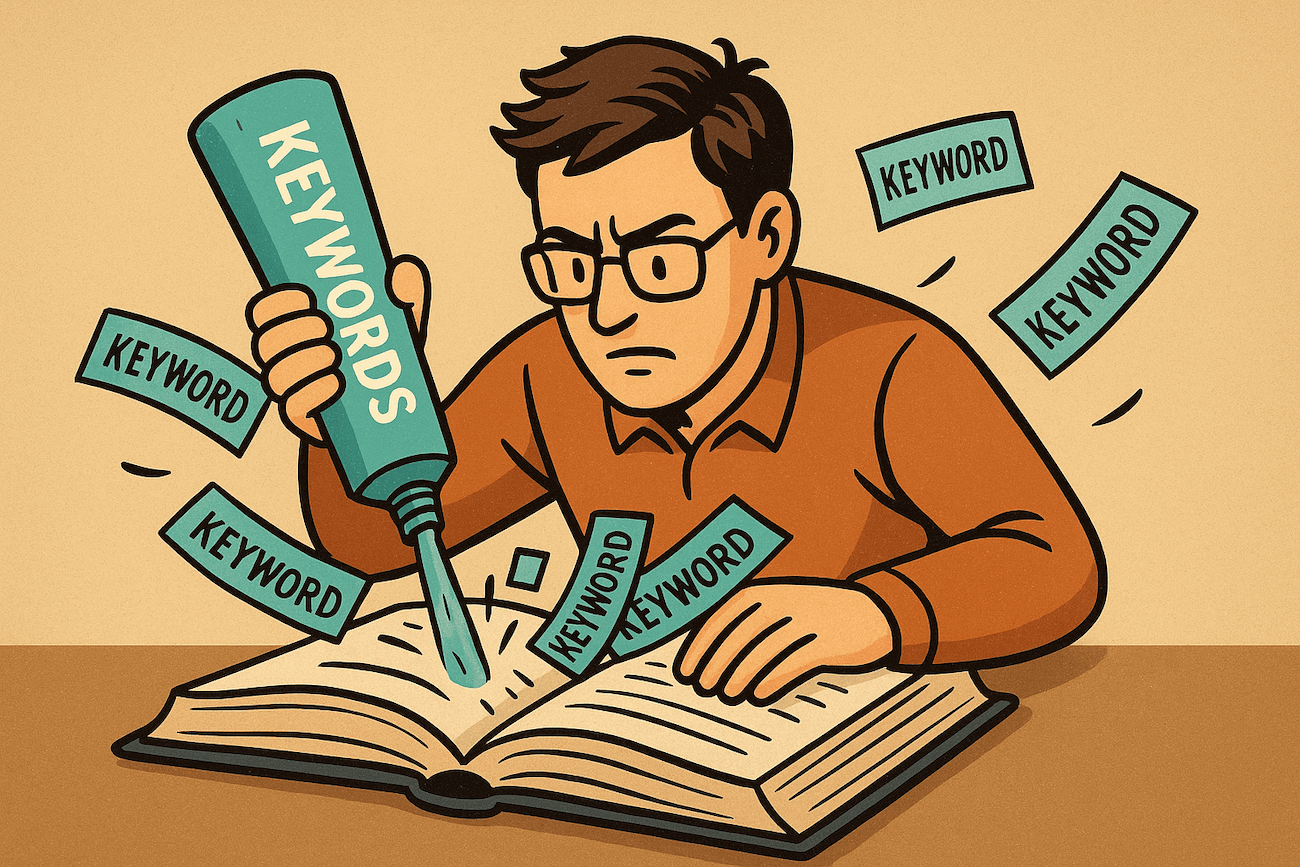
Now that’s a very long book title to read and digest, but this is not a rare example. It’s commonplace now for authors to cram extra words, tropes, and search terms into a title to attract book buyers. But why is it happening, and how does it work?
What is book title keyword stuffing?
Keyword stuffing is as old as the Internet. It’s the practice of including as many keywords as possible in online text, particularly in articles and blog posts.
As an example, if you wanted to rank on search engines and get more traffic for “cheap children’s shoes,” you would include the phrase five, six, or even more times in an article.
Search engines clamped down on this practice many years ago, and it no longer works. In fact, it has the opposite effect now and is one of the great sins of SEO (search engine optimization).
Yet, it’s a practice that seems alive and well on the Amazon Kindle Store. The slight difference is that repeating the same word or phrase doesn’t work.
Instead, book title keyword stuffing involves cramming as many different search terms (keywords) as possible in the title and subtitle fields.
Authors who publish with Amazon KDP know keywords are important and can use seven specific keyword fields when preparing a new book for publication.
But these fields are hidden from book buyers, and don’t appear anywhere on a book’s product page on Amazon.
They are used in the background as metadata to prompt Amazon’s search algorithm to display results based on a user’s search query.
Because these seven keywords are hidden, with no way of really knowing if they work, some authors started to include a keyword or two in subtitles.
What started as a little trick by a few is now becoming standard practice with Amazon book titles.
To borrow from Douglas Adams, the answer is 200.
That’s the maximum character count Amazon allows for the combined book title and subtitle field.
Here’s a quick image to show you precisely how long a book title can be on Amazon. The titles in the image are all close to 200 characters. That’s right on the limit, so it’s obviously intentional.
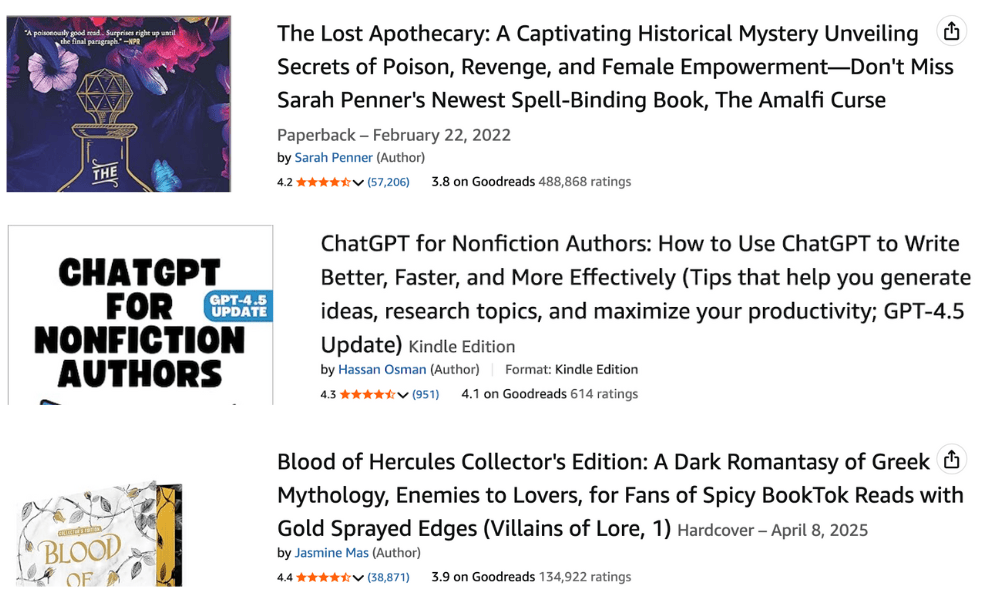
By comparison, the seven keyword fields have a 50-character maximum.
But the big deal is that the title and subtitle are clearly visible, while the seven keywords are not.
It also makes it much easier to validate that any keywords in a title work when searching for books.
When you think about it, it makes sense. Generally, book titles have always been very short. Often only two, three, or four words. Think here of The Da Vinci Code, or even 1984.
That was great in the past, when a memorable title counted. Now, though, selling new books isn’t about being memorable; it’s about being searchable and discoverable on Amazon.
That’s why you are now seeing much longer titles when you go to the Kindle Bookstore.
Could Amazon do something about this? Perhaps. But reducing the character limit could affect normal, natural, long titles.
Think here of famous books like “The Curious Incident of the Dog in the Night-Time,” or “The Personal History, Adventures, Experience and Observation of David Copperfield the Younger of Blunderstone Rookery.”
But the new title tendency is not literary; it’s purely financial.
You might think keyword-stuffed book titles seem pretty inoffensive. It’s hard work trying to sell a new book, so what’s the harm in trying to make a book more saleable?
But from a book buyer’s point of view, it can become a bit tiresome wading through titles that are a jumble of disconnected words.
It looks like and is sales copy, and no longer a book title.
For authors, it’s a dilemma. Using more words in a book title may be the new trend to help sell more books. But at the same time, does it cheapen a book?
Tactics used to try to game the system on Amazon are not new. It’s been a constant battle of cat and mouse for years.
However, most have usually been subtle or working in the background.
But this new practice of book title keyword stuffing, along with even more word stuffing in book descriptions, is becoming tedious to read.
While it might be a great idea and useful fodder for attracting the attention of Amazon’s algorithms, it’s not great for readers or authors who value their work.
Does title stuffing work?
If the aim is to cram a title with words and phrases that will appear in search results, it works.
I checked a handful of books with stuffed titles, and the results were similar. Most books appeared on the first page of search results.
However, it’s much harder to compare this with the effectiveness of the seven hidden keywords that every book has.
The only way I could check was to search for keywords that I had used for my own books. The result wasn’t very good. Hardly any appeared in search results. However, words and phrases from my titles all appeared in search results.
That’s not a very scientific way to check, but on the surface, I would have to say that keywords in a book title seem to be more effective.
Title stuffing gives authors a visible and immediate way to test their keyword strategy, which is likely why some authors rely on it over the hidden KDP fields.
If you are a new self-publishing author, should you optimize your book title for Amazon?
All I can say is that using a subtitle has always been a good idea, and it is useful for increasing your chances of your book appearing in search results.
However, it needs to be logical and easy to read. If you overstuff it with additional keywords and phrases, you might win the Amazon algorithm, but not win readers.
Will the title trick keep working? That depends on Amazon and whether it wants to tackle the issue.
Amazon has a long history of cracking down on tactics when they become too widespread or believe that they negatively affect its customers.
Will Amazon penalize book title keyword stuffing? Perhaps.
If it does take action, it could be bad news for authors and books using the technique, and result in a sudden loss of visibility.
Conclusion
Selling books today is hard.
With so many new titles being published every single day, the competition for readers is fierce.
That’s why there are always new schemes, tactics, ploys, and tools to help rise above the rest on Amazon and other online book retailers.
While title stuffing might be the latest KDP keyword strategy to gain an advantage, it certainly won’t be the last tactic to try to gain a competitive edge on Amazon.
If you choose a well-crafted book title with a natural subtitle, you’re always safe.
Title stuffing up to the Amazon book title limit is a gamble that might be useful today, but it could be risky tomorrow.
Related Reading: 10 Smart Things To Do After Self-Publishing Your Book

English teacher, writer, and author. Passionate about grammar, creative writing, and self-publishing. Always exploring new tools and tech to help writers succeed.