When you buy an ebook online, do you really purchase it like a paperback, or only rent it? And if there is a difference, what restrictions come with either choice?
Depending on where you buy an ebook, you might be agreeing to terms that limit what you can do with it.
Many major ebook retailers use Digital Rights Management (DRM) to control how you can or cannot read, copy, or back up your ebook files.
Before you click that very convenient “Buy Now” button, it is worth understanding what these limits mean and how you can buy, keep, and even share the ebooks you purchase.
Why does DRM matter when you buy an ebook?
What is an ebook? An ebook is a digital book, similar to a long webpage made up of text and images. Like webpages, some are freely available, while others are protected and limit how and where you can read them.
Ebook retailers such as Amazon Kindle, Google Play Books, and Apple Books use Digital Rights Management (DRM) to control how you use the ebooks you buy.
DRM limits your ability to back up, copy, lend, or update your files because retailers place strict restrictions on the ebooks you purchase.
Proprietary file types lock your ebook purchase inside a single ecosystem, often called a walled garden, such as Amazon’s Kindle format or Apple Books.
So, DRM is how companies control digital files even after you think you have bought them.
The much-publicized stories of a user’s Kindle being wiped of all previous purchases by Amazon and Barnes and Noble’s limit on updating an ebook after a credit card expires are examples of how ebook control can work.
Do you really own ebooks with DRM? Unfortunately, no. You are only renting them.
Licensing agreements restrict what you can and cannot do with an ebook and give retailers significant control over your purchases.
But who reads the fine print or terms and conditions when they buy an ebook?
Probably not many of us. So, what can you do to ensure that when you buy an ebook, you buy it with no or next to no limitations?
How can you really buy an ebook?
The easiest answer is to buy DRM-free ebooks in .epub format.
Most popular e-reading devices can read .epub files. But the Kindle device is an exception.
For Kindle users, the most suitable is the .mobi file type, which is also DRM-free. However, this file type is being phased out. But now you can send .epub files to a Kindle using the Send to Kindle app or by email.
Some retailers are now offering ebooks that are both DRM-free and in popular file types to suit almost all e-reading devices.
Smashwords, Draft2Digital, and Kobo are at the forefront of DRM-free ebook sales.
Another very useful tool to use to ensure you own your ebooks is Calibre.
If you can’t locate a DRM-free version of an ebook for your device on your preferred retailer, see if you can buy or download a DRM-free epub version of the ebook elsewhere.
Then, use Calibre to convert the ebook file to the type used by your device.
Amazon Kindle DRM-free ebooks
You can sometimes find Kindle ebooks on Amazon that do not use DRM.
But you have to hunt, and there are not many of them.
Amazon certainly doesn’t make it easy to tell, either.
Instead of stating that a particular ebook is DRM-free, you need to check the Product details section.
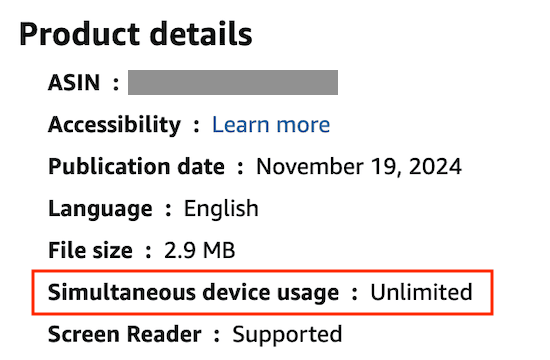
If there is an entry for “Simultaneous device usage : Unlimited,” the ebook is not protected by DRM.
Convenience vs. ownership
While one-click purchasing and instant delivery to your device may seem appealing, the drawbacks often outweigh this convenience.
Perhaps when you would like to lend your purchased ebook to your spouse and then discover you can’t, for instance.
Just an extra few seconds spent at the time of purchase may bring you many more advantages.
One of the simplest ways to load DRM-free ebooks onto most devices is with email.
Almost all e-reading devices have an email facility.
It is just a matter of downloading or buying the correct file type or converting using Calibre and then emailing the file to your e-reader.
Open and start reading.
Then, you know that you have really purchased an ebook that, like physical books, you can share, lend, copy, back up, and keep forever.
Major ebook retailers and DRM policies
Amazon Kindle Store
DRM: Yes (default)
DRM-free: Rare, publisher-controlled
Amazon applies Kindle DRM to most ebooks. Some independent publishers choose to sell DRM-free titles, but the majority are locked to Kindle apps and devices.
Apple Books
DRM: Yes (Apple FairPlay DRM)
DRM-free: Not for most commercial titles
Apple Books allows reading DRM-free EPUBs you upload yourself, but ebooks sold through the Apple Books Store generally use Apple’s DRM. In the past, publishers could opt out, but today, DRM is the norm for store purchases.
Google Play Books
DRM: Optional
DRM-free: Yes
Google Play Books is one of the most flexible platforms. Publishers can choose DRM or DRM-free, and many titles can be downloaded as EPUB or PDF files for personal use.
Kobo Store
DRM: Yes (Adobe DRM)
DRM-free: Yes (publisher-controlled)
Kobo supports both DRM-protected and DRM-free ebooks. Many independent publishers and smaller presses sell DRM-free titles.
Barnes & Noble (Nook Store)
DRM: Yes
DRM-free: Very rare
Most Nook ebooks use DRM tied to the purchaser’s account. DRM-free titles exist but are uncommon.
Smashwords
DRM: No
DRM-free: Yes (all titles)
Smashwords is fully DRM-free by design. Readers can download ebooks in multiple formats without restrictions.
Leanpub
DRM: No
DRM-free: Yes
Leanpub specializes in technical and non-fiction books and sells all titles DRM-free in PDF, EPUB, and MOBI formats.
Gumroad (ebooks sold directly by authors)
DRM: No
DRM-free: Yes
Authors selling ebooks via Gumroad typically provide DRM-free files, though protection depends on the seller’s setup.
Summary
Yes, you might have to change your ebook buying habits.
But if you buy DRM-free ebooks, you can save and share them with friends or read them on different devices or reading apps.
Another benefit is creating a library and backing up all your ebooks for safekeeping.
The choice is up to you.
But understanding the difference between convenience and true ownership means that when you buy an ebook, you can really own it.
Related reading: How You Can Lose All The Ebooks You Purchased Because Of DRM

English teacher, writer, and author. Passionate about grammar, creative writing, and self-publishing. Always exploring new tools and tech to help writers succeed.