For twenty-five years, or even longer, publishing online has been the most popular way for writers to connect with readers.
I belong in the “even longer“ group, and publishing my writing online has become a way of life for me.
Today, however, writers face new headwinds from AI-generated answers, unpredictable social platforms, and diminishing organic search traffic.
So, is publishing online still worthwhile for writers? The answer is yes, but probably not for all the same reasons as in the past.
Why writers started publishing online
1997-8 was a time of a kind of Wild West attitude and innocence when Excite, Lycos, AltaVista ruled as search engines and Netscape Navigator was the dominant browser.
As for building websites, Microsoft FrontPage was one of the most popular because it was an easy-to-use WYSIWYG editor.
All of these gave writers, especially, all the tools they needed to start online publishing.
Virtual neighborhoods like GeoCities sprang up, and a little later Open Diary (1998) and LiveJournal (1999) opened more avenues.
It felt like an explosion of options, and as ezines and article directories emerged, writers found more ways to connect directly with readers.
Back then, the internet was largely home to two types of people: creators and consumers.
Consumers bookmarked their favorite sites. Creators happily kept producing new content for them.
What also worked brilliantly for writers was how simple discovery felt: if you could publish it, search engines would list it.
But as we know, giants like Google and Facebook grew to dominate a few years later and changed the innocence and freedom of the internet forever.
It was the end of that wonderful period of invention, innocence, and freedom, but not the end of writers publishing online.
What’s changed for writers?
The question should be, what hasn’t changed?
Up until late 2022, the internet matured, but the basics stayed pretty much the same.
Writers were the heartbeat of the web, and search engines rewarded useful content with visitors. That became the unwritten deal between writers and search engines.
However, AI (artificial intelligence) changed the rules, and almost overnight, the internet would never be the same again.
AI assistants, AI search, and especially AI Overviews increasingly summarize and present writers’ work without sending readers to the original source.
The result has been a growing problem with how the knowledge, creativity, and expertise of writers are attributed.
A byline and copyright still matter, but they no longer guarantee that readers will reach the source.
Fewer clicks, and in some cases zero clicks, have resulted in a rupture in the longstanding unwritten deal between publishers and search engines.
So much so that major publishers are now considering the unimaginable of opting out of Google Search.
The trend is clear. You can see in the graph below by SpyFu how five of the major online publishers have lost, and continue to lose, organic traffic since the end of 2022.
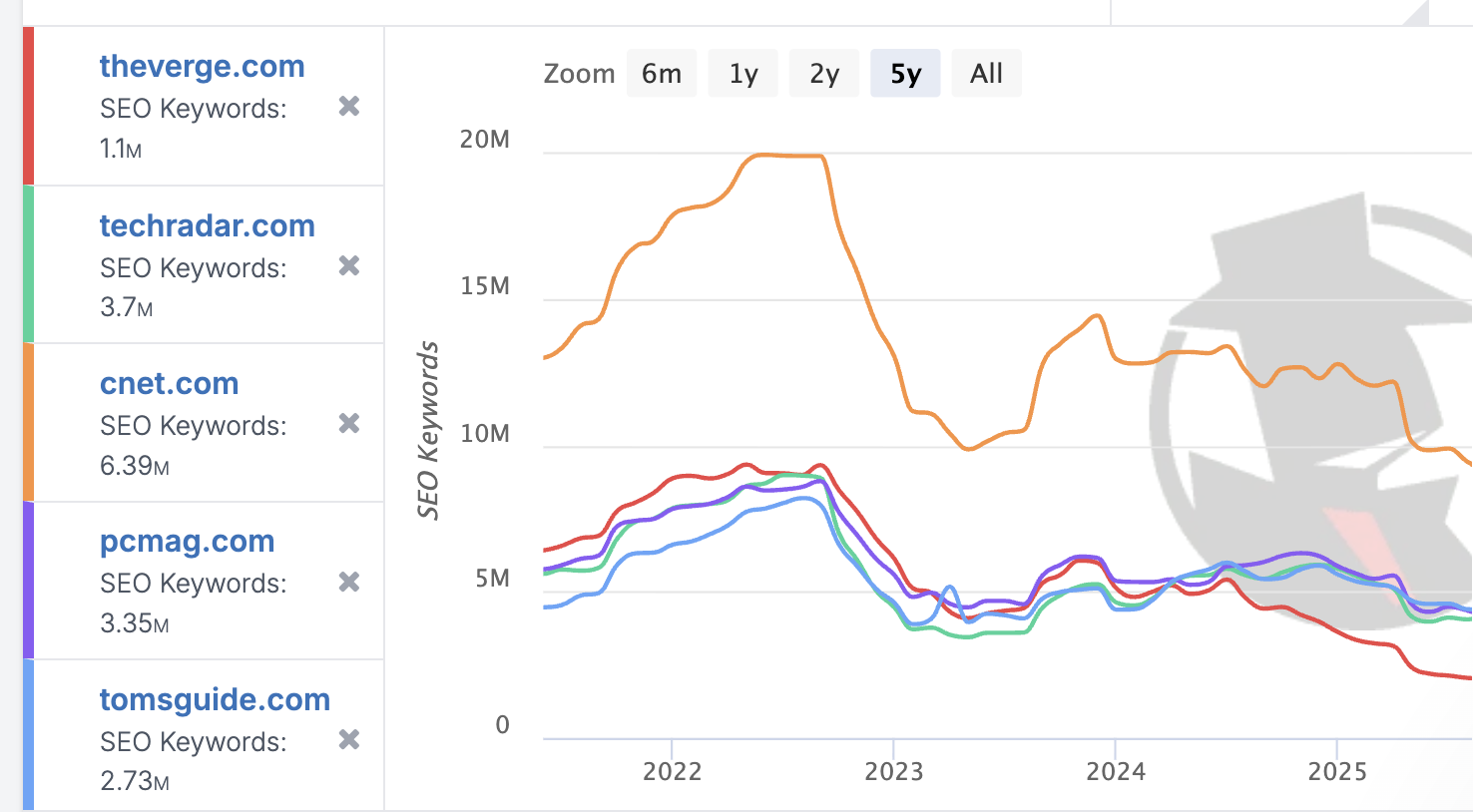
Added to this have been efforts by many popular platforms such as Medium, Reddit, and Pinterest to keep users within their walls and discourage extensive outward links and clicks.
Of course, AI has enabled the creation of content at scale, which is flooding the internet and creating even more competition for writers. Yet despite all these dramatic changes, writers continue to do what writers have always done.
They write. They publish. And increasingly, they still publish online.
The goal is no longer to chase every possible visitor. It is to build a body of work that helps the right readers find you, wherever they discover your writing.
Why publishing online is still worthwhile
In one word, ownership.
No matter how much has changed in how content is delivered, writers still own their original work.
A website is one of the best places to publish and archive your writing. A publication date helps establish when your work first appeared, while your site remains a permanent home for your original content.
Also, keeping an offline library or file is a second layer of security.
Like a business, writers don’t have a problem with production and warehousing, or customers. The problem today is that delivery has become unreliable.
In a way, we became too comfortable. Writers, myself included, relied almost entirely on search engines, and Google in particular, to deliver readers.
Now that this delivery chain is much weaker and often fickle, writers need to take ownership of delivering their writing.
And that’s easier said than done. But there are other platforms, routes, and means of connecting with readers. You need to hunt for steady but smaller streams of traffic from many other places.
Often this can mean creating slightly different versions to suit a platform, but the core and ownership remain the same.
Readers still abound, and in far greater numbers than when I first started publishing my writing online.
Yes, I’ve had my ups and downs over the last few years with AI affecting my delivery.
But I still have readers, I still receive messages, and I still keep writing. And I still keep searching for new ways to deliver.
So yes, publishing online is still worthwhile because it’s still much easier and faster, and will deliver many more readers than offline print publishing.
Helping readers discover you and your expertise
The days of readers bookmarking and following their favorite blogs and writers are long gone.
Today’s readers are often snack readers who flit from one article to the next.
Because of this, not every article or essay you write will succeed. But you can improve your chances when you understand how online readers function.
I like to call it the 30-second rule. It focuses on what a reader sees, reads, and decides during the first few moments after arriving on one of your articles.
The longer you can keep a reader’s attention, the more memorable you and your writing will become.
When you can do this consistently, readers are more likely to bookmark an article or remember your name or website, and return later.
It’s not easy to rely on analytics now due to the huge increase in bot traffic. But I do see a trend of more users arriving directly on my site.
It takes time, but every article you publish online becomes one more doorway for people to discover you and your area of expertise.
What doesn’t work anymore
In one word, again, keywords.
Writers who have been publishing online for a while will remember when using a keyword like “absolute adjectives” eight or nine times in an article almost guaranteed a top search ranking.
Those days are long gone, and the practice was dying out well before AI arrived.
But popular SEO tools like Google Search Console, Bing Webmaster Tools, Semrush, and Ahrefs still present much of their data through keywords and search queries.
The reason is that AI search and AI assistants rely much more on understanding intent and context than matching exact keywords. Current analytics tools haven’t really caught up with that shift yet.
User behavior has also changed. In the past, users searched with short phrases or queries, such as “free writing software.”
Now, however, they have quickly adopted much longer queries due to AI search, like “I want to start writing a memoir and would like to know what software I need and if I can find one for free.”
What this means for writers is that content now has to answer real questions rather than simply target search phrases.
Instead of a listicle article of ten free writing software and apps, an article should now focus on why, when, and how to choose and use free writing software, including the advantages, limitations, and which option is best suited to different writers.
While AI search and assistants often answer questions without sending readers to the original source today, that will probably continue to evolve as AI search matures.
Summary
I’ve been publishing articles online for years now.
Traffic has changed dramatically during that time. But I still publish new articles because each one adds another useful resource to my site and another opportunity for readers to discover my work.
Would I recommend that new writers publish their work online? Yes, without a doubt.
While a writer can still get an article, essay, or even poems published in a local newspaper, an ezine, or literary magazine, none of these has the global reach of the internet.
And that’s the big difference and huge advantage of publishing writing online. As long as you concentrate your efforts on delivery, you have an almost unlimited audience for quality writing.
My parting thought is that unlike products such as phone books and yellow pages, VHS tapes and VCRs, floppy disks, and pagers (beepers), writing is a product that is very much alive and well with a ready market.
What has changed isn’t writing. It’s how you deliver it.
Related Reading: The Publish Button Is A Writer’s Most Powerful Tool

English teacher, writer, and author. Passionate about grammar, creative writing, and self-publishing. Always exploring new tools and tech to help writers succeed.