
A character profile template is one of the best ways to create believable characters in your fiction writing. If you’re not sure where to start, or you want a simple way to organize your ideas, this free character builder can help you.
Use the tool below to quickly set up a complete character profile. Add personality traits, background details, and story elements, then download your finished profile as a fully editable DOCX file ready to use in your writing.
If you prefer a more hands-on approach, you can also use a printable PDF template to design your own character sheet.
Best of all, you don’t need to sign up or provide an email address. Just start building your character below.
Create a Complete Character Profile in Minutes
Simply click “Start Building Your Character” and enter some details to begin creating your profile. You can even include an image to bring your character to life.
When you’re ready, download your completed profile as a fully editable DOCX file.
Fiction Character Profile Builder
Once you’ve added a few details, your character profile is ready to use in your writing.
You don’t need to complete every field, but adding the basic information will give you a solid foundation.
Because your download is fully editable, you can continue developing your character at any time.
Save your file so you always have a clear reference to return to while writing your story.
A well-structured character profile helps keep your writing consistent and makes it easier to understand how your character thinks, behaves, and reacts.
You can, and should, update your profile as your story develops and your ideas expand.
This tool is your starting point, and you can return to it whenever you create a new character.
When you’re ready, scroll down to learn how to get the most out of your character profile.
How to Get the Most from the Character Profile Builder
The following simple tips will help you create more detailed, consistent, and believable characters.
Start by filling in the basic details such as your character’s name, age, gender, and profession, as these give you the foundation to build on.
The quick bio section is where you can expand on these basics by adding a short general description of your character.
Another useful step is to include an image to help you visualize your character more clearly. You can search free stock photo sites or use an AI tool to create a realistic image that matches your idea.
An image makes it much easier to bring a character to life, especially if you are writing in genres like science fiction or fantasy.
Once you have the basics in place, work through each section of the tool to build out your character in more detail.
These elements will influence how your character thinks, speaks, and reacts throughout your story.
The last section of the tool focuses on what your character really wants and what is standing in their way, which is where conflict and story tension begin.
Even a simple goal or obstacle can make your character feel more realistic and give your writing a stronger sense of direction.
However, you don’t need to complete every field in one go, and it’s often better to build your profile gradually.
Start with the essentials, download your profile, and then continue adding, editing, or refining the details in your word processor.
Note: Your downloaded file is designed to work smoothly in Microsoft Word, Google Docs, Scrivener, and most word processors. However, some apps, such as Apple Pages, may slightly adjust spacing or layout.
If you prefer a minimalist approach, you can even download a blank profile from the tool and use it as a reusable template. Alternatively, you can use the PDF template below to create your own custom character profile design.
If you want to understand why character profiles are so useful, here’s a quick explanation.
What Is a Character Profile Template?

If you are planning to write a book or even a short story, you need interesting characters to write about.
You might already have a few ideas in your head, but they are often not fully developed, and a short bio of a couple of sentences is rarely enough.
As your story progresses, there will be many moments when you need to refer to specific details about your characters.
Without a clear reference, it’s easy to lose track of small details, which can lead to inconsistencies in your plot.
When I first started writing, I had no idea about building a character profile template.
That led to plenty of mistakes in my early drafts, because I was writing by the seat of my pants without a clear structure.
Writing a book benefits from at least some planning and organization, especially when it comes to developing strong characters.
If you detail as much as you can before you begin, you’ll have a quick and reliable reference you can use as you write your story.
It might take a little time to complete your profile, but it will help you develop richer characters and save you time in the long run.
How to Create a Character Profile
There are a lot of choices for book writing software. Many of the premium versions come with a bio template or profile cards. You can usually add as many sections as you wish, as well as a character image.
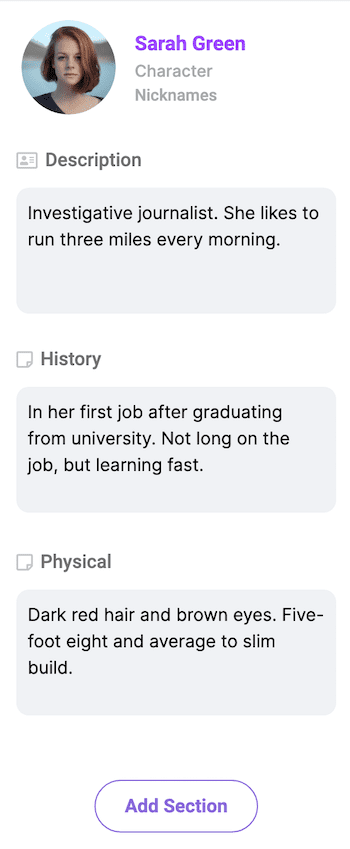
But you don’t need to buy software to create as many profiles as you need for character creation. It’s very easy to detail all the information about a character’s life by creating a simple character template in Microsoft Word or Apple Pages.
Here is an example of creating a fiction profile template, complete with some details.
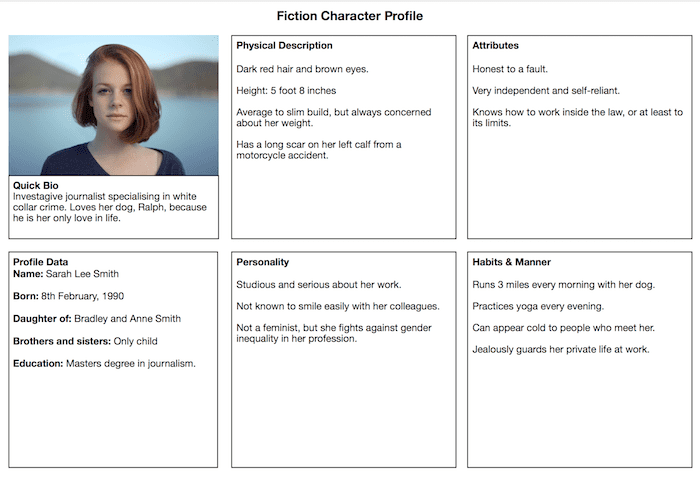
A good profile will have as much information as possible to form a complete overview of your character. Here are some essential traits and details you will need to include once you’ve created your template.
The Surface Cluster (The Persona): Focus on appearance, gait, and voice. This is the mask your character wears in public. Ask yourself: How do they want the world to perceive them?
The Social Cluster (The Anchor): Focus on status, education, and relationships. This defines their “place” in your world. Ask yourself: What does this character have to lose if their reputation is ruined?
The Shadow Cluster (The Inner Conflict): Focus on regrets, phobias, and vices. This is where the real story lives. Ask yourself: What is the secret flaw that will eventually sabotage their goal?
You can always add more elements if you wish, such as:
- Short bio
- Personal data
- Physical description
- Personality traits
- Positive and negative attributes
- Mannerisms and habits
- An image
You might not use all of the information in your story. Simple things like knowing a birthday and astrological signs might not seem necessary.
But as your story develops, character development questions and small details like this can sometimes crop up. When you’re well prepared, you won’t confuse a reader by using two dates in your story.
If you write historical fiction, dates are a big issue, and it is so easy to get things wrong or out of order.
If a character lived in the 17th century, a birth date of August 1725 would be wrong. It should be 1625.
When you write, interesting characters should always be showing the story to the reader. The more details you know about them, the more depth you can give to your story.
Download Your Bio Template
If you do a Google search, you can find many free templates to download.
But many want your email address before you can download a template or profile worksheet.
If you are like me, you want to avoid getting even more marketing emails. But it’s up to you.
It’s really so simple to do it yourself by making a simple Word or Pages template.
All you need to do is set up your new document in portrait or landscape and save it as a template.
You can add as many text boxes as you think you will need. I also add an image holder. I’ll cover more on that later.
Here is what my basic template looks like.
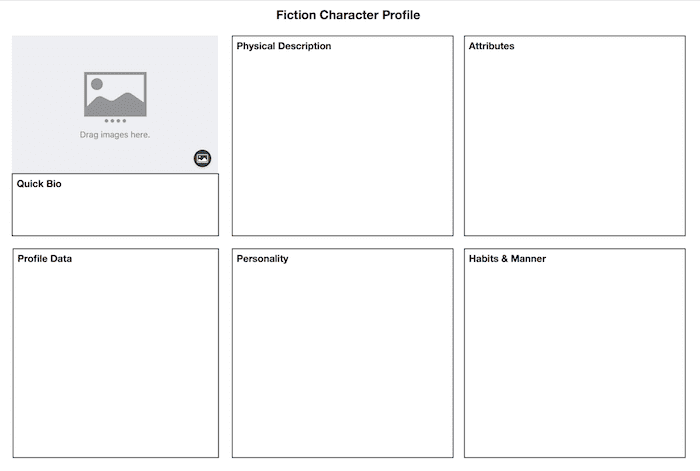
You can download my template in PDF if you click the image above.
And no, you don’t need to hand over your email address to get it.
You are welcome to print it out if you are happy to write details by hand. Or, if you know how to do it, you can edit and annotate the PDF file.
But, if you prefer, you can create your own template like this in less than five minutes.
Why You Should Add an Image
There is nothing better than a visual image of your main characters. If you have a picture in your bio template, it will help you a lot when you write.
It doesn’t need to be anything spectacular. But a picture that is representative of what you have in mind is a great idea.
Where can you find an image?
You are not going to use or share your image online. You are only going to use it for your template. So you can use almost any image you can find.
The best places to start looking are royalty-free stock image sites. There are thousands upon thousands of photos you can choose from.
You can find many images of people, fantasy images, and even aliens. Here is one I found on Pixabay.
It’s okay to show you this image because the Pixabay License says it is free for commercial use, and no attribution is required.

You can also search the Internet and even social media platforms for an image that looks like what you have in your imagination.
But if you intend to share your profile image or images, always make sure you check the license information first.
It is essential if you plan to use an image for your book cover.
Summary
I have tried many different ways of creating a good character profile template.
For some time, I kept bullet point notes and spreadsheets and then tried writing long descriptions.
But with a bit of experience, I found that breaking up the information into boxes helped make the details and information clearer and easier to remember and reference.
When you write, you can add more details to each text box as they appear in your story, so you keep building real-life character details.
Then you won’t fall into a fact trap later in your book.
There is no better or the best way to lay out your profile templates.
But not having profiles when you start writing your book is one of the most common mistakes for an inexperienced writer.
When a problem comes up in the plot, it means wading back through the whole manuscript, trying to find mentions of perhaps hair or eye color or important dates.
It’s always a great idea to get to know your characters as best as you can before you write.
Your story will flow better and more naturally and be factually accurate.
Related reading: Learn How To Get Your Dialogue Punctuation Right Every Time

English teacher, writer, and author. Passionate about grammar, creative writing, and self-publishing. Always exploring new tools and tech to help writers succeed.


Thanks for the info. I needed that.
This is incredibly useful information as I hadn’t though if that. Thank you for sharing. I’m going to take your advice and do this!