

When you describe the weather in writing, you set the scene for your story or a part of your story.
It’s an opportunity to show readers the setting rather than tell them about the weather using a couple of quick adjectives.
Using highly descriptive or figurative language and a variety of grammar structures helps you paint the picture vividly in a reader’s mind.
In almost every story, both fiction and nonfiction, there is usually at least one reference to the weather.
How To Describe The Weather in Writing

We all know this famous opening line from Edward Bulwer-Lytton’s 1830 novel, Paul Clifford.
It was a dark and stormy night.
Many have criticized the phrase, and Writer’s Digest went as far as to call it the literary poster child for bad story starters.
The main issue is that it uses two very weak adjectives: dark and stormy. Neither of them is usefully descriptive.
The second problem with the phrase is that it starts with a grammatical expletive.
When writing about the weather, using it was, or there was is a common writing fault. It’s because we so often refer to the weather as it.
But few people take into account what follows Bulwer-Lytton’s famous clause.
It’s a pity because the complete sentence is a wonderful example of how to describe the weather in writing.
It was a dark and stormy night; the rain fell in torrents—except at occasional intervals, when it was checked by a violent gust of wind which swept up the streets (for it is in London that our scene lies), rattling along the housetops, and fiercely agitating the scanty flame of the lamps that struggled against the darkness.
He uses descriptive noun phrases, strong verbs, and powerful adjectives. The combination of these three elements paints a vivid picture for readers.
Choosing Your Vocabulary
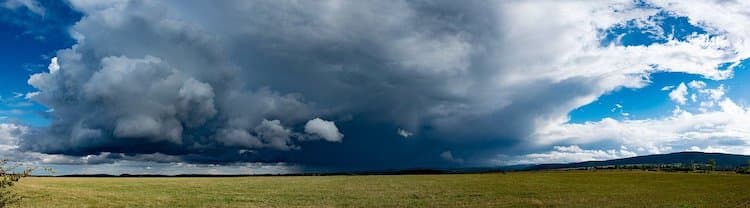
You can find many lists of common and unusual words to describe the weather, so you have plenty of choices.
But you should avoid words that are too simplistic. It was hot, cold, windy, or rainy are all very weak expressions.
But if you describe the heat, the cold, the wind, or the rain with noun phrases, you can improve these easily.
The sun started baking early across the plains, delivering a scorching promise for the day ahead.
The cruel icy wind cut like a knife across her cheeks.
Rain, as always, arrived too little, too late to save the crops.
Words that are not widely understood are also worth avoiding. While it’s interesting to find new words, not all of them are useful.
A good example is petrichor. It is the smell or scent of rain arriving after a period of dry weather.
But it is difficult to use, and it might send readers hunting for a dictionary.
The petrichor gave a hint of hope to the farmers.
It would be better to use a descriptive phrase.
The sweet far off scent of rain on dying grass gave hope to the farmers.
Brontide is another, meaning the sound of distant thunder or rumblings of an earth tremor. Again, it’s a great word to know, but with very limited use in writing.
Try This Simple Formula
Anytime you need to write about the weather, keep this little trick in mind.
Start with a noun phrase, use a strong verb, then add a descriptive clause.
You also need to describe the noun and verb with adjectives and adverbs.
Here’s a quick example.
The heavy dark clouds rolled slowly and low across the parched pastures, but they were heartbreakers, as not a drop of rain fell before the cruel wind carried them away.
It’s an easy way to make sure you avoid the grammatical expletive and weak adjectives.
You can also experiment with similes or metaphors. For example, raining cats and dogs.
Use Verbs That Sound Like The Weather
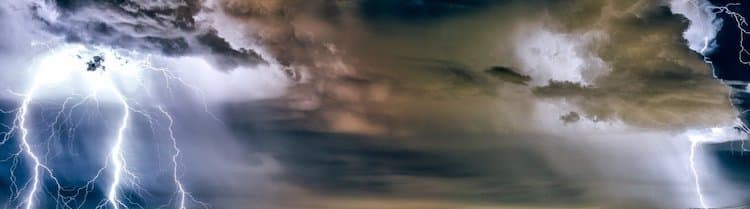
Onomatopoeic verbs and words are perfect for describing the weather because they make a sound.
Here are a few examples to illustrate sound words.
The pitter-patter of raindrops.
Thunder rumbled overhead.
Light hail pinged on the window pane.
With each step, the fresh snow crunched underfoot.
A bolt of lightning cracked across the night sky.
A cold north wind hissed through the trees.
A sudden boom of thunder forewarned us of the approaching storm.
Verbs and words like these are extremely useful because they are action words and highly descriptive.
Now let’s move on to a couple of advanced techniqes.
Using Weather as an Emotional Tool: The Pathetic Fallacy
If you have ever read a scene where the sun smiles down, the sky weeps, the wind whispers, or the rain cries, you have seen the Pathetic Fallacy in action.
Coined by critic John Ruskin, this technique involves attributing human emotions and responses to nature or inanimate objects.
In writing, it is a powerful way to use weather to reinforce the mood of your scene or the internal or emotional state of your characters.
1. Mirroring the Mood
This is the most common use of the technique. The weather acts as an echo of the character’s feelings.
The Scene: A character feels trapped and hopeless.
The Weather: A thick, suffocating fog rolls in, obscuring the path ahead and muffling all sound.
2. Creating Contrast (Irony)
Sometimes, the most effective weather is the kind that clashes with the mood. This highlights a character’s isolation.
The Scene: A character receives devastating news.
The Weather: A bright, cheerful spring morning with birds chirping and a mocking, cloudless blue sky.
3. Foreshadowing
Weather can act as a warning to the reader that the status quo is about to change.
The Scene: An impending confrontation or a sudden turn for the worse.
The Weather: The clouds shift to a bruised, sickly purple, churning low over the horizon like a predator circling its prey.
Writer’s Tip: Use the Pathetic Fallacy sparingly. If the weather always matches your character’s mood, your writing can start to feel a bit melodramatic. Aim for subtlety to keep the reader interested.
Weather and the Five Senses
You can also move beyond the visual when writing about the weather.
While telling a reader the “sky was grey” provides a basic image, using the other senses, such as sound, touch, and even smell, can put the reader into the character’s shoes.
When you describe the weather, try to use at least two different senses to ground the scene.
For example, instead of just describing a storm, mention the vibration of the thunder in the character’s chest or the metallic tang of the air before the first bolt hits.
Quick Reference: The Sensory Weather Cheat Sheet
The table below gives you some quick examples of imagery and descriptors for the four most common weather conditions.
| Weather Type | Sight & Imagery | Sound & Touch | The Scent (Smell) |
|---|---|---|---|
| Heat | Shimmering haze; scorched earth; bleached horizons | Stifling air; prickling sweat; leaden lethargy | Baked asphalt; dry grass; dust-heavy wind |
| Rain | Silver needles; leaden skies; rhythmic ripples | Rhythmic drumming; damp chill; squelch of mud | Petrichor (rain on dry earth); wet pavement; sodden moss |
| Cold | Frosted glass; skeletal trees; iron-grey mist | Numbing bite; crunching snow; sharp inhalation | Woodsmoke; sharp pine; crisp sterility |
| Storm | Bruised sky; flickering light; churning clouds | Static charge; lashing spray; booming thunder | Ozone; metallic tang; damp concrete |
Notice the inclusion of smell in the table above.
Scent is the sense most closely linked to memory and emotion.
Using a word like Petrichor (the scent of rain on dry earth) doesn’t just describe the weather; it can give a specific, or even nostalgic feeling to the reader.
Similarly, touch (tactile description) creates immediacy.
If the cold isn’t just “there” but is actually “biting” at a character’s nose, the reader feels the the scene more vividly.
Conclusion
This article is not a lesson or lecture on how to describe the weather in writing.
It’s purely a reminder that you can always improve.
I have listed a few ideas above, but there are many more ways you can make the weather more interesting.
All it takes is to remember that the setting for a scene or a story needs careful thought and imagination.
But if there are two key takeaways from my article, they are these.
1. Avoid using the grammatical expletive when referencing the weather.
2. Use noun phrases and strong verbs.
If you do those two things, the rest of your weather scene setting will come very easily.
Related reading: How To Describe Smells In Writing Readers Can Sense

English teacher, writer, and author. Passionate about grammar, creative writing, and self-publishing. Always exploring new tools and tech to help writers succeed.