

I’m publishing blog posts every few days, but my author blog still isn’t getting readers.
If that sounds familiar, you’re not alone. Many writers and self-published authors start a blog hoping it will bring attention to their books, only to find that traffic is slow and engagement is almost non-existent.
The problem usually isn’t effort. It’s direction.
An author blog doesn’t succeed just because you publish regularly. It grows when each post is written with purpose that is designed to attract readers, hold attention, and guide them toward your work.
Work smart, not hard
Improving your author blog isn’t about publishing more or working longer hours.
It’s about making better decisions with every post you publish.
Small changes in structure and clarity often have more impact than simply writing more articles.
A well-focused post will always outperform a longer post that lacks direction.
The goal of author blogging is to make your content easier to find, easier to read, and easier to trust.
That means writing with a clear purpose and a clear reader in mind every time.
Successful blogs tend to follow simple, repeatable patterns that make content predictable and easy to read.
Clarity is even more important now because AI search tools and summaries often extract short, structured sections from articles.
If your content is clear and well organised, it has a better chance of being selected and reused in those systems.
The tips below focus on these fundamentals to help your author blog become more effective and discoverable.
10 Ways to improve your blog
The following ten-point list will help guide you toward making some relatively simple adjustments to your article writing.
They will make your blog work much better for you and help you attract more loyal readers. For any writer who writes blog posts regularly, they are easy to apply to your new and existing articles.
Most of the tips relate to creating a better user experience for your readers. In other words, they make your website or author blog more enjoyable to read.
If you think no one reads your blog, it’s time for some changes.
1. Research your blog post titles
The few words you choose for your blog post title are the most important words in your great article. They are the first words people see in Google Search and social media. You need to choose words that instantly attract attention.
Your title also needs to give readers a very clear idea of what your article is about and why they should read it. Before deciding on a title for a blog post, check how well the words perform on Google Search.
Another great way to check is to use a Headline Analyzer.
Here is the result of my headline for this article.
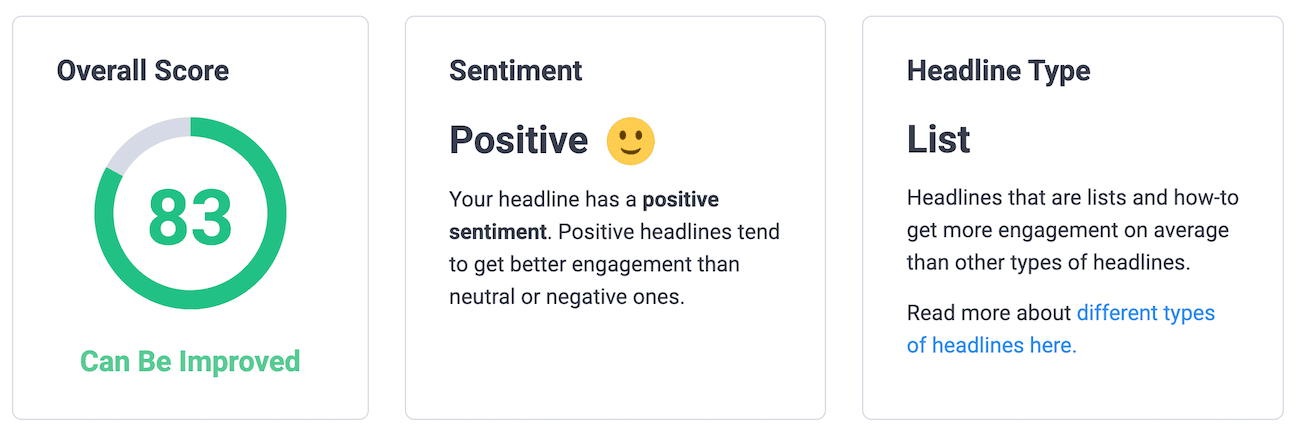
I’m usually happy with a score above 70, but you can experiment and try for yourself. Try to include at least one emotional and one power word because they attract attention.
Check some of your existing blog post titles to see how they rate. You can always change the title on your existing posts.
Most importantly, a good title for a search engine is between 50 and 55 characters and contains fewer than 11 words.
You can take an extra step and do some SEO keyword research for your articles.
2. Use very short paragraphs
A blog article is not a book.
Reading blog articles on laptops, phones, and tablets is a very different reading form.
It has to be very easy on the eye, so use a lot of white space. It means that big, chunky paragraphs are out.
As a rule of thumb, use no more than two short sentences together. Break up very long sentences into smaller, bite-sized sentences.
Ideally, the text should be dark grey, not black, on a white or pale background.
Your choice of font is also important. A sans-serif font like Arial works much better than a serif font like New Times Roman.
The last element is the font size. Don’t make readers squint.
Experiment with the font size for your body text so it is very easy to read.
3. Use more images
While one image is okay, more images are much better.
You need at least one featured image that will appear when your post is shared.
But for a reader, more images not only help inform or entertain but also help break up your text and make it more comfortable to read.
Try to add at least two more images if you have a word count of around 1,000 words.

But don’t go stealing images. The image above is from Canva, a free online image maker.
You can also use free stock photos and images or, better still, take your own photos.
4. Talk to your readers
Do you use the first or second person in your articles?
Cut down on I and me, and concentrate on using you and your. That’s your reader. Write to them.
You will notice the difference immediately, won’t you?
Your writing process needs to be directed toward your reader. Inform them and help them solve their problems or answer questions they may have.
I want you to succeed in blogging and sell more books.
So I’m writing this article, especially for you. Why? Because you are very important to me.
5. Help your readers
It’s not what you write about; it’s how you write about it.
Do your articles entertain, inform, or, more importantly, answer questions readers have?
If you write about yourself, can your experience help your readers?
The best blogs write articles that help readers. A common way to help your readers is to write more how-to articles.
Great blogs are also very focused on one particular theme or topic.
They become a reliable resource for readers, who then return, return, and return, comment, or ask questions.
It is the process that builds your blog authority.
A quick and easy way to get ideas for a blog post is to take a look at questions being asked on Quora.
You can also get new ideas by looking for questions people ask on social media or in comments on other blogs.
Select your blog theme or topic and then narrow it down to questions that attract a lot of attention and answers.
It doesn’t matter if your topic is Architecture or Zoology; questions always need answers, and you can help someone.
Always remember that your blog is not about you; it is about your readers.
If you think no one reads your blog posts, change your approach and become helpful.

6. Stay focused
A good blog remains very much on the topic.
No one reads a blog that is merely a daily diary or a writing scoreboard and is overloaded with book promotions.
There is very little content to interest blog readers.
Pick your topic and stick with it. Become a reliable expert, and you will gain loyal blog readers.
For an author, it doesn’t necessarily have to be a topic related to writing and books.
But perhaps a topic that is related to your book themes and subjects.
It could be your historical knowledge, your region, something culinary, or even rose cultivation.
Become an expert that readers can trust.
7. It’s old news
Blog articles that can be read over and over again by new readers are called evergreen content.
It means that your article will remain relevant for years to come.
Don’t go to all the effort of writing a long blog post that will be dated by next week. No one reads a blog post that is old news.
Write long, informative articles that will stay alive and readable for a very long time.
They will keep attracting readers through Google Search and social media sharing.
Don’t forget to check and update your articles from time to time to make sure they are of continuing interest to your readers.
8. Add headings
Headings give structure to your article and help readers navigate if they skim through it.
They are also very helpful to Google, which likes logical headings when indexing your post. But they are not just bold words.
Headings are categorized as H1, H2, H3, and so on. On any blogging platform, you can add these from your editor.
H1 is usually your title and is added automatically. But you will need to add one H2 for your sub-title and then H3 for subsequent paragraph headings.
You can use bold, italic, and underline within your text to add emphasis.
9. Use internal links

If a reader likes what you are writing about, give them more.
You can do this by adding internal text links to your most popular articles to guide readers to your new articles.
To do this, select a few words in your text, then add a link to send a reader to another one of your articles, as in the following sentence.
You should know how to use links and, especially, how to add internal links to your articles.
A good rule of thumb is to add up to three internal links in a 1,000-word article.
You should also add links from a couple of older articles to your newest article.
One near the beginning is to keep a reader on-site who may not be hooked by the article.
Add another one about halfway through for a reader who has read enough.
And most importantly, add one near the end for readers who loved your article so much and want to read more.
Don’t disappoint them.
Sharing your article yourself helps a little bit.
But not nearly as much as getting readers to share your article on social media.
The easiest and quickest way to get readers to your blog and articles is through social media shares.

It might not be as effective as it was some years ago, but it’s still an option you can try to find more readers for your blog.
There are many free tools available for all blogging platforms to add social sharing buttons.
Summary
If you are worried that no one reads your author blog, there is always room to improve.
That’s what I do, day in, day out. But you don’t have to work at it full-time.
The most important factors for a popular blog are to post regularly and to promote your articles.
Perhaps once a week or three times a month. Then, you can occasionally check to make sure your older articles are up to date.
If not, you can make a few quick edits or additions.
Hopefully, these ten points will give you ideas about improving your blog and articles and attracting more readers. Then, hopefully, sell more books.
For new writers ready to start blogging, use these tips to get your blog off to a flying start.
All of these tips can be used to improve your existing articles. Make some changes and update your old articles to make them shine.
For your new articles, you now have a new way of thinking, writing, and presenting your work to your readers.
Related reading: 10 Must-Read Self-Publishing Blogs For Authors And Writers

English teacher, writer, and author. Passionate about grammar, creative writing, and self-publishing. Always exploring new tools and tech to help writers succeed.



Interesting. Thanks for the article.
Very helpful–thanks!
Thank you so much for such practical and specific suggestions! I feel so much more prepared to continue working on my blog.
Thank you, Derek. I think this is the best article I’ve seen on this subject – appreciate the help!
Excellent post and advice!